The 2026 NCAA gymnastics season officially begins this weekend, featuring a series of meets including a highly anticipated matchup as Utah hosts Iowa and Minnesota on January 6, 2026. With significant offseason changes in coaching, team rosters, and rules, fans are eager to see how these developments will shape the competition. Will the Oklahoma Sooners continue their dominance? Can challengers like LSU, Florida, and UCLA step up?
Oklahoma’s Quest for Another Title
The Oklahoma Sooners enter the season as the reigning champions, having secured their seventh NCAA title in 11 eligible seasons. The team’s impressive track record since winning their first title in 2014 has established them as a dynasty in collegiate gymnastics. After a surprising semifinal exit in 2024, the Sooners rallied to reclaim their championship status last April.
Despite graduating key figures such as reigning all-around champion Jordan Bowers and 2024 NCAA bars and beam champion Audrey Davis, Oklahoma retains senior Faith Torrez, who finished third in the 2025 all-around competition. Additionally, a strong recruiting class, including talents like Mackenzie Estep and Ella Murphy, is expected to make an immediate impact. The Sooners are currently ranked No. 1 in the preseason coaches’ poll as they aim for their first Southeastern Conference (SEC) trophy.
The Competitive Landscape of the SEC
The SEC remains a powerhouse in collegiate gymnastics, with seven teams ranked in the top 10 of the preseason poll, and all nine teams within the top 12. The LSU Tigers, the reigning SEC champions and the 2024 NCAA title holders, are ranked No. 2. Under the guidance of former NCAA all-around champion Haleigh Bryant, LSU’s roster features junior Konnor McClain, who is expected to compete in all four events after recovering from an Achilles injury.
Meanwhile, the Florida Gators, ranked No. 3, boast a roster filled with notable talent despite the graduation of Leanne Wong. Key returning gymnasts include Skye Blakely, a member of the U.S. world team, and Kayla DiCello, a 2024 Olympic alternate. Florida’s depth is evident, with 11 gymnasts capable of competing at vault with a 10.0 start value, suggesting they could be strong contenders for their first NCAA title since 2015.
Other teams such as Missouri, Alabama, Kentucky, and Arkansas also look poised for strong seasons. Arkansas welcomes back sophomore Joscelyn Roberson, who won a world bronze medal on vault, alongside senior transfer Morgan Price, noted for her six WCGNIC titles.
Star Power and Fresh Faces
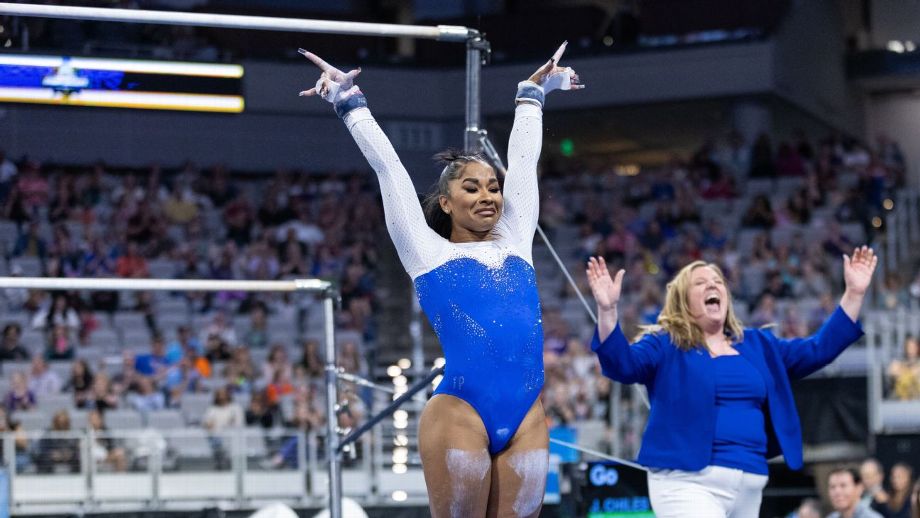
One of the most talked-about figures in NCAA gymnastics remains Jordan Chiles, who returns to UCLA as a standout athlete after her viral performances on “Dancing With the Stars.” The Olympic gold medalist hopes to lead her team to a national championship in her final collegiate season. Chiles will be joined by promising freshmen, including former national team members Tiana Sumanasekera and Ashlee Sullivan, who have already shown great potential.
Other notable newcomers include Ana Barbosu of Stanford, a former elite gymnast from Romania, and Charlotte Booth, who is set to debut for Auburn after recovering from an Achilles injury. Additionally, Scarlett Sonnenberg, the first five-star recruit in BYU’s history, is expected to make a significant impact after winning the all-around title at USAG’s level 10 nationals.
Rule Changes Impacting the Season
Several rule changes will affect the 2026 season, most significantly the adjustments to the national qualifying score (NQS). Previously calculated based on six meets, the NQS will now factor in a minimum of nine meets, providing a more comprehensive assessment of team performance. To ensure fairness, a maximum of five home meets can be included, along with a mandatory minimum of five away meets. This alteration aims to enhance competitive integrity by emphasizing consistent performance across various venues.
In addition, only one neutral site meet within 30 miles of a school’s campus can be counted as an away meet, with any additional meets deemed home competitions. These changes, as outlined by the NCAA, are designed to offer a more accurate representation of each team’s overall success throughout the season.
As the season unfolds, excitement builds around the potential storylines and key performances. The championship culminates on April 18, 2026, in Fort Worth, Texas, where a new national champion will be crowned. The journey to that moment begins this weekend, as teams across the nation take to the floor.