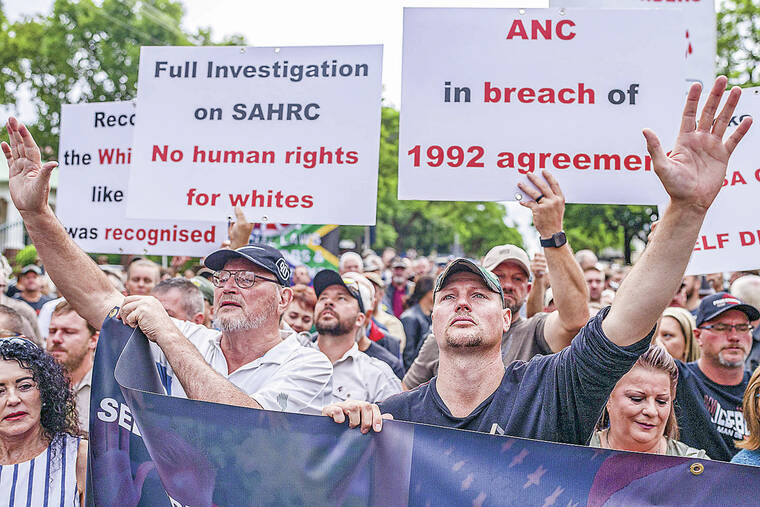
UPDATE: Afrikaners are experiencing a historic shift in access to U.S. diplomatic channels, following a series of recent meetings with high-ranking officials in Washington. This unexpected welcome marks a significant change in U.S. policy under President Donald Trump, who has taken a strong stance against the South African government, citing the alleged persecution of Afrikaners.
Just announced: In a surprising twist, prominent Afrikaner leader Theo de Jager revealed that his recent visit to the U.S. included discussions with officials from Vice President JD Vance’s office and other key diplomats. De Jager noted that U.S. officials are now eager to hear about the challenges facing Afrikaners, a stark contrast to previous administrations that largely ignored their concerns.
The urgency of this development cannot be overstated. Since assuming office, President Trump has implemented sweeping measures against South Africa, including a halt to U.S. aid and imposing 30% tariffs on South African imports. Just last month, he announced that South Africa would be excluded from the upcoming Group of 20 summit in Florida, asserting that the plight of Afrikaners justifies these actions.
The State Department is increasingly engaging with Afrikaner organizations, a shift that has allowed figures like Jaco Kleynhans from the Solidarity Movement to communicate weekly with U.S. officials. Kleynhans expressed that the level of access to U.S. policymakers has “increased tremendously” in the past 10 months. This newfound visibility is providing Afrikaners with opportunities to influence U.S. foreign policy relating to South Africa.
The U.S. Embassy has even begun sharing social media content in Afrikaans, demonstrating a commitment to bridging the gap with Afrikaner communities. Kleynhans highlighted that discussions surrounding issues like farm killings and tariffs are now commonplace, allowing for a direct exchange of information with embassy officials.
Former U.S. Ambassador to South Africa Patrick Gaspard remarked on the dramatic changes, noting that Afrikaners were previously viewed as “peripheral” actors during his tenure. He stated, “It’s kind of astonishing for me to see just how much oxygen they’re getting right now with Trump world.” This sentiment is echoed by former diplomat Todd Haskell, who emphasized the shift in focus towards Afrikaner rights, a stark contrast to past U.S. engagements centered on broader issues.
The annual Independence Day celebration at the U.S. Embassy this year showcased an unusually large presence of Afrikaners, further indicating their growing significance in U.S.-South Africa relations. Business leader Gerhard Papenfus expressed gratitude for the Trump administration’s outreach, declaring, “Here’s an administration that reaches out and says, ‘We hear you.’”
However, this newfound attention is not without its complications. Tensions are rising within South Africa as some lawmakers call for investigations into Afrikaner organizations, alleging that they are spreading misinformation detrimental to U.S. relations. Activist Kallie Kriel of AfriForum suggested that the U.S. is leveraging its relationship with Afrikaners due to the South African government’s engagements with countries like Iran, indicating a broader geopolitical strategy.
While Afrikaners have always had the opportunity to engage with the U.S. Embassy, the current administration’s focus has taken many by surprise. De Jager recounted an encounter at a recent diplomatic event where a U.S. diplomat recognized him for an open letter he had written to Trump, highlighting the administration’s attentiveness to their concerns.
As this situation unfolds, all eyes will be on how U.S.-South Africa relations evolve with the increasing prominence of Afrikaner voices. The implications of these developments could reshape diplomatic dynamics in the region, making it a critical story to watch in the coming months.
Stay tuned for more updates as this situation continues to develop.