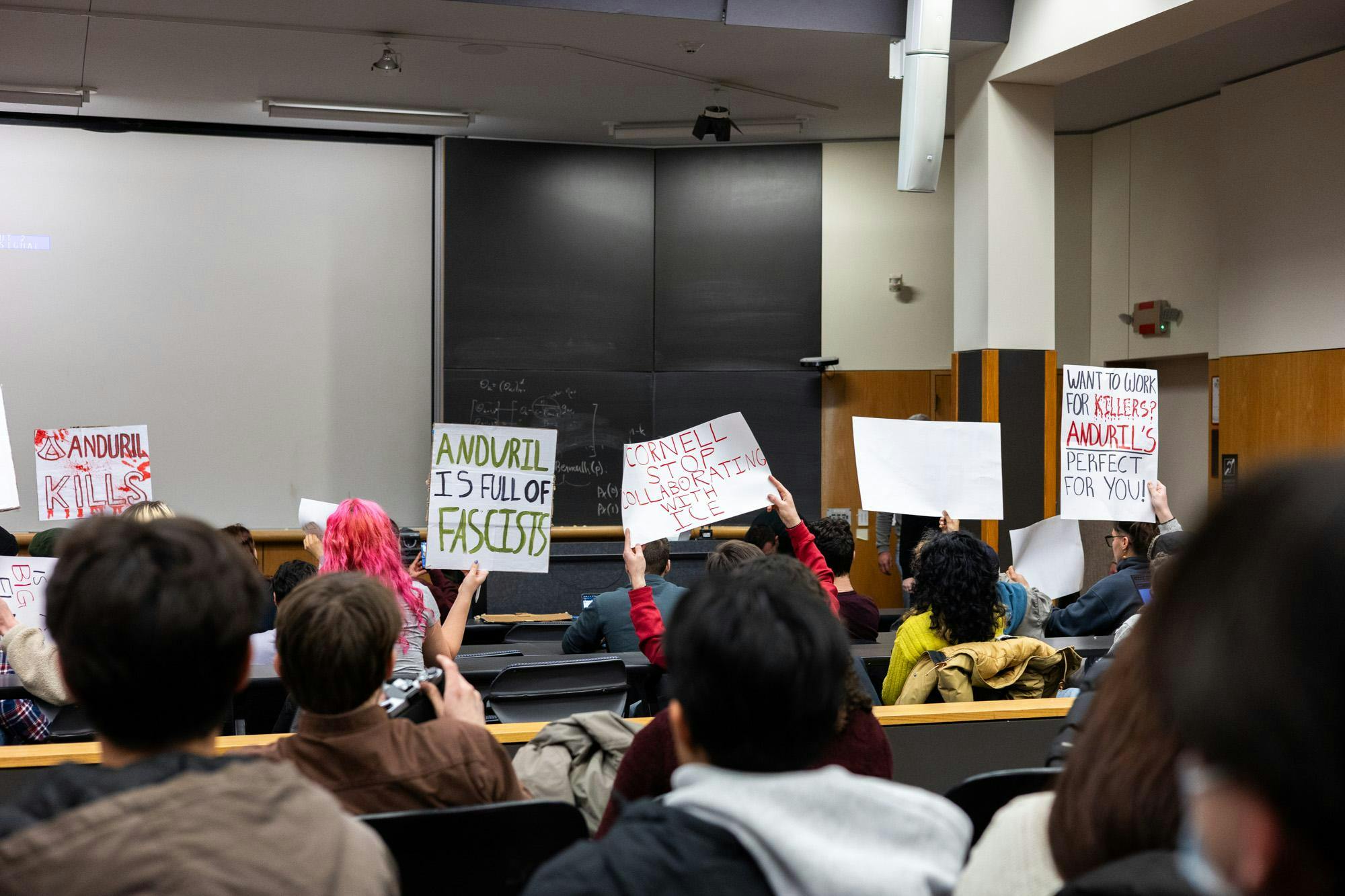
Protesters disrupted a “Tech Talk” hosted by defense technology firm Anduril Industries at Cornell University on October 19, 2023. The event, aimed at engaging engineering students and promoting employment opportunities, was intended to last for two hours but ended abruptly after just seven and a half minutes due to vocal opposition from demonstrators.
As students entered Phillips Hall 101, they encountered protesters distributing leaflets that criticized Anduril’s products, particularly highlighting the “Fury,” an AI-powered, semi-autonomous unmanned aerial vehicle. The flyers contained stark statements about the potential consequences of such technology, including the assertion that it is designed to operate alongside manned aircraft and could threaten civilian lives. One flyer provocatively read, “Does this look sleek? Soon, it’ll slaughter a family,” emphasizing concerns about the ethical implications of defense technologies.
Protesters pointed to Anduril’s involvement in manufacturing drones and surveillance technologies for the U.S. Customs and Border Protection, alleging that these tools pose risks to migrants fleeing violence. They claimed that the company has benefited from policies allowing the sale of AI-driven weaponry to nations accused of human rights violations, such as Israel and Saudi Arabia. The leaflets concluded with pointed questions, urging students to reconsider career choices in the defense industry.
The event began with Christine Nye, Associate Dean of Students with Student Support and Advocacy Services, reminding attendees of Cornell’s commitment to free speech. She stated that while speakers have the right to present their views without intimidation, dissenting audience members could express their opinions as long as they did not disrupt the presentation. Despite this, the talk quickly descended into chaos as protesters lifted signs and shouted at the presenters when it became clear that the session would not include a question-and-answer period.
Organizers of the protest, including representatives from Cornell Progressives and Students for Justice in Palestine, had spent over a week urging the university’s Career Services to cancel the talk. Adrianna Vink, president of Cornell Progressives, expressed disappointment that the recruiters were not prepared to engage with students who had come ready to discuss their concerns about working for a company they view as complicit in violence and oppression.
Vink stated, “The people here today are concerned students who showed up — you saw people made signs, people prepared questions, people were ready to engage with these recruiters.” She emphasized the importance of making their values clear to the university community.
Another protester, Francis Burns, echoed these sentiments, stating the aim was to raise awareness among Cornell engineers regarding the implications of their potential career paths. He remarked, “We’re trying to show engineers that these are unacceptable career paths and let people know that it is socially unacceptable to work for these companies.”
The protest drew a significant police presence, with officers stationed inside and outside Phillips Hall. This incident follows recent controversies at Cornell regarding the promotion of job opportunities with the Customs and Border Protection, raising questions about the university’s partnerships with organizations linked to contentious practices.
In response to the backlash, Shannon Prior, head of communications at Anduril, characterized the event as a success. She noted that the company had received several job applications shortly after the talk. “We even had students emailing our recruiters apologizing for the disturbance,” she stated.
When asked about the decision to proceed with the event despite student opposition, Prior affirmed Anduril’s commitment to free expression. She described the protests as “perplexing,” arguing that the company supports the U.S. military, which she claims safeguards the freedoms that allow for such demonstrations. Furthermore, she expressed pride in Anduril’s support for service members, despite the protests against the firm.
As the event concluded, Vink reiterated the significance of student participation in shaping the future of the defense industry, asserting, “Your labor is critical to these systems of violence and oppression, and that is the reason why these recruiters are coming here.” She called on her peers to reconsider their involvement in industries that contribute to harm, emphasizing the power of collective action in advocating for social justice.
The incident at Cornell highlights ongoing tensions between educational institutions and the ethical implications of partnerships with defense contractors, raising important questions about the role of students in advocating for their values within academic environments.