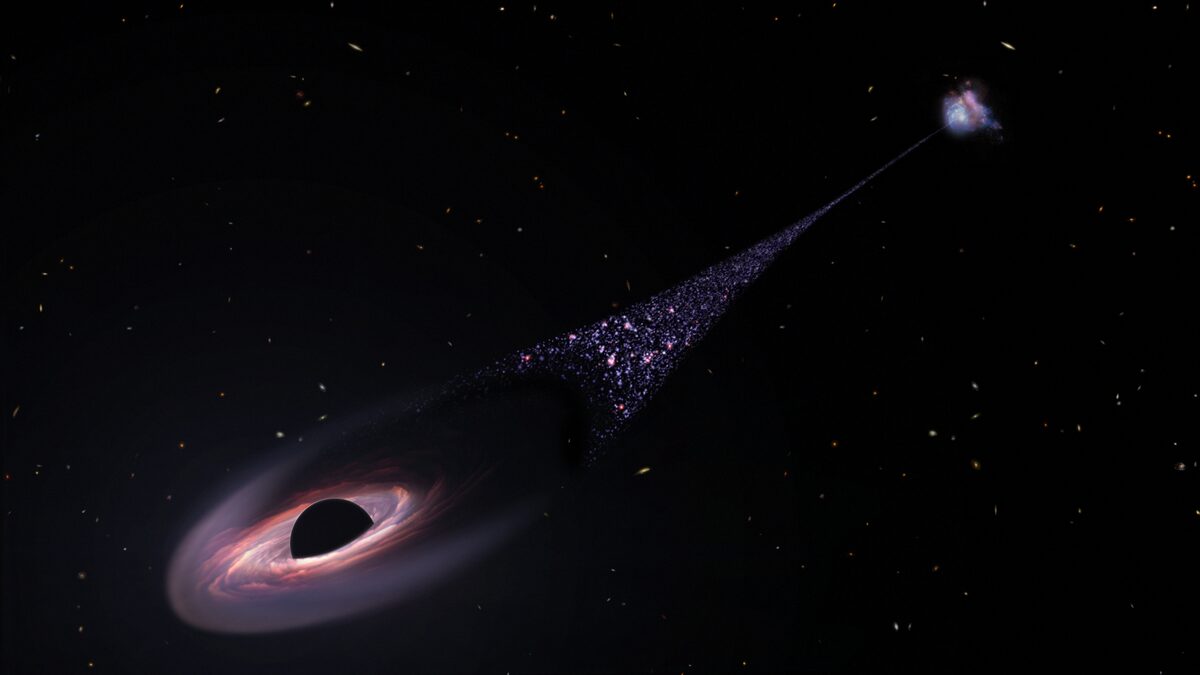
Astrophysicists may have identified a runaway supermassive black hole, designated as RBH-1, traveling through intergalactic space at an astonishing speed of more than 3 million kilometers per hour. This potential discovery challenges existing understanding of how such colossal entities, typically anchored at the centers of galaxies, could become unmoored and race through the cosmos.
The findings emerged from routine observations made with the Hubble Space Telescope. Astronomers were examining a nearby dwarf galaxy when they noticed a peculiar, elongated structure of light. Subsequent analysis revealed that this structure, located approximately 7.7 billion light-years from Earth, spans around 200,000 light-years—about twice the width of the Milky Way galaxy—and consists of a mixture of gas and stars. Notably, one section of the structure emits light equivalent to nearly 50 million suns.
Competing Theories on RBH-1’s Origin
The discovery team proposed multiple interpretations, including the possibility that the structure represents debris from a galactic collision or gas ejected from a high-velocity galaxy. Ultimately, they concluded that RBH-1 is likely a supermassive black hole that has been expelled from its host galaxy, trailing material as it speeds through space.
While the concept of a wandering black hole might seem improbable, several mechanisms could account for such an event. One scenario involves the merger of two galaxies, where their respective black holes spiral towards each other. If the merger is asymmetrical, it can result in a black hole being propelled away at high velocity due to an intense release of energy in the form of gravitational waves. Additionally, in a more complex interaction involving three galaxies, one black hole could be ejected while the others form a binary system.
Despite the intriguing evidence presented, another research team challenged the runaway black hole hypothesis. They suggested that the structure could be an exceptionally flat, “bulgeless” galaxy, which lacks a central bulge of older stars. Such galaxies are rare but can produce similar visual characteristics when viewed edge-on.
This alternate interpretation raises questions about the plausibility of a supermassive black hole generating enough material wake to form new stars and suggests that the time since the ejection event—estimated at 39 million years ago—is too brief for significant star formation to have occurred.
The Ongoing Debate and Future Observations
The scientific discourse surrounding RBH-1 continues, with researchers divided between the runaway black hole and flat galaxy hypotheses. Both sides rely on extensive data and theoretical frameworks developed over years of astronomical investigation. The debate exemplifies the scientific method, where hypotheses are tested, challenged, and refined.
Recent observations using the James Webb Space Telescope have added complexity to the discussion. The original discovery team analyzed infrared spectra from RBH-1 and published their findings in the Astrophysical Journal Letters. They argued that the velocity changes observed—approximately 600 kilometers per second—align with expectations for a black hole interacting with intergalactic gas.
Conversely, the dissenting team, who published their analysis in Research Notes of the AAS, posited that the data better fit the profile of standard star-forming gas clouds rather than shock waves from a black hole.
At this juncture, it is premature to definitively categorize RBH-1 as either a runaway black hole or a rare galaxy. Both scenarios present compelling narratives for astronomers, whether it be a colossal black hole forging new stars or an unusual galaxy formation.
This ongoing debate illustrates a critical aspect of scientific inquiry: uncertainty drives exploration and understanding. As astronomers continue to gather data and refine their observations, the true nature of RBH-1 remains an open question, fostering excitement and engagement within the scientific community. The future may hold the key to unlocking the secrets of this enigmatic object, revealing more about the complex dynamics of the universe.