URGENT UPDATE: The Kilauea volcano in Hawaii is experiencing a significant escalation in activity, with a new lava fountaining episode expected to occur between December 22 and 27, 2025. This eruption, which began on December 23, 2024, has been characterized by intense lava-fountaining episodes that have not been seen in nearly four decades.
The ongoing eruption has created a breathtaking spectacle for visitors to the Hawaii Volcanoes National Park, but it also poses serious hazards. Recent events highlight the unpredictable nature of volcanic activity, reminding us of the risks associated with this dynamic environment. As of now, the eruption is paused, but scientists have observed intermittent glow at the south vent, indicating that activity could resume at any moment.
The current eruption style features sustained high fountaining, with molten lava shooting up to 460 meters (1,500 feet) into the air, dramatically reshaping the landscape around the Halema‘uma‘u crater. The USGS Hawaiian Volcano Observatory (HVO) has documented this unprecedented activity in real-time, thanks to modern technology including satellite observations and live-streaming cameras.
Historically, only three similar eruptions have been documented at Kilauea: the 1959 Kilauea Iki eruption, the initial fountaining phase of the 1969-74 Maunaulu eruption, and the early episodes of the Pu‘u‘o‘o eruption from 1983 to 1986. The current eruption, however, stands out due to the sophisticated monitoring capabilities available today, allowing scientists to forecast eruptions and assess hazards more effectively.
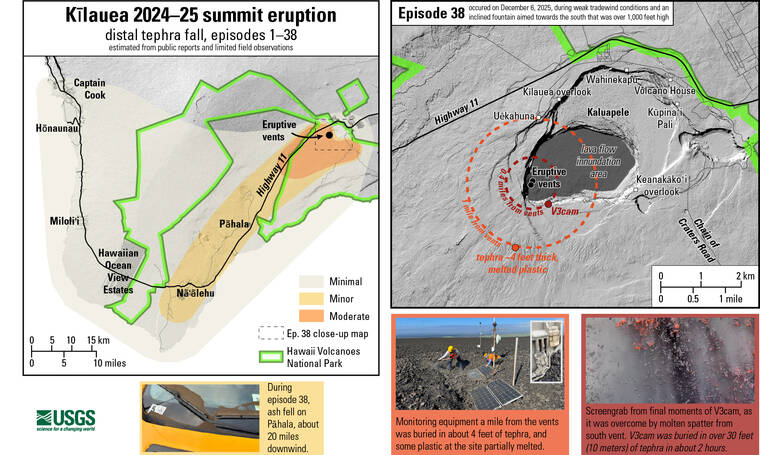
During the most recent significant episode, Episode 38, which occurred on December 6, 2025, lava fountains reached heights of over 300 meters (1,000 feet). The south vent’s geometry changed abruptly during this episode, leading to powerful inclined fountaining. The impact was severe; tephra deposits blanketed the area, causing HVO’s Sand Hill monitoring station—located approximately one mile from the vent—to become buried under 1.2 meters (4 feet) of ash.
The dangers associated with this eruption extend well beyond the immediate vicinity of the volcano. Hot tephra has been known to fall several miles away, affecting not only park visitors but also nearby communities. Volcanic air pollution, commonly referred to as vog, can spread across neighboring islands, impacting air quality significantly.
As the HVO continues to monitor Kilauea closely, teams of geologists and engineers are actively assessing the ongoing changes. They are digging out buried monitoring stations and measuring tephra deposit thickness, which will help them understand the eruption’s evolution. Geodesists and seismologists are tracking ground deformation and seismic activity, crucial for predicting when the next fountaining episode may commence.
This eruption offers a unique opportunity to witness the power and beauty of Hawaiian fountain eruptions. However, safety remains paramount. Areas around the Kilauea summit that are closed to the public are restricted for everyone’s safety due to life-threatening hazards that can change rapidly.
The USGS Volcano Alert Level for Kilauea remains at WATCH, indicating that the volcano is actively erupting episodically. As we await the next phase of this extraordinary natural event, authorities urge the public to heed all safety guidelines issued by the Hawaii Volcanoes National Park.
For those eager to stay informed, the HVO’s website is an excellent resource for updates, photos, maps, and more information about Kilauea and Mauna Loa. Please direct any inquiries to [email protected].
Stay tuned for more updates as the situation develops—this is a momentous time for Kilauea, and the world is watching.