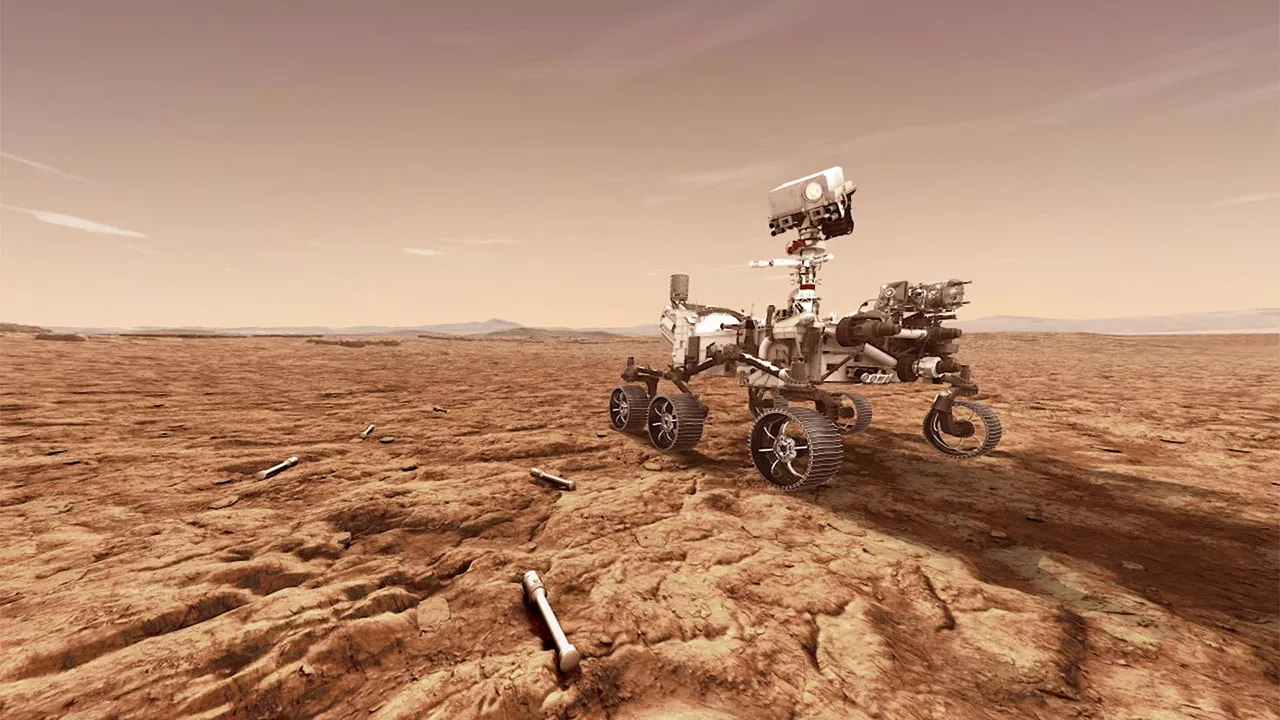
BREAKING: NASA’s Perseverance rover has potentially discovered a meteorite on Mars, identified as a shiny rock nicknamed ‘Phippsaksla’. This finding, just announced in an official blog post, reveals high levels of iron and nickel, suggesting it may have originated from an ancient asteroid.
The rover, which landed in Jezero Crater on February 18, 2021, has spent nearly four years exploring the Martian surface. This latest development adds Perseverance to the list of rovers that have detected extraterrestrial materials on Mars, a significant milestone for NASA’s $2.7 billion mission.
Scientists first noticed Phippsaksla in the rugged terrain beyond the crater’s rim, where its metallic sheen stood out against the flat landscape. Subsequent tests using Perseverance’s SuperCam revealed unusually high concentrations of iron and nickel, elements typically found in meteorites rather than native Martian rocks.
If confirmed as a meteorite, Phippsaksla would join notable discoveries made by previous missions, including Curiosity’s finds of meteorites known as ‘Lebanon’ and ‘Cacao’. Each of these discoveries has deepened our understanding of how cosmic visitors interact with the Martian surface over time.
NASA’s analysis indicates that Phippsaksla sits atop impact-formed bedrock, offering scientists clues about its formation and journey to its current location. The SuperCam, which fires a laser to analyze material composition, provides crucial data from several meters away, enhancing our understanding of this potential meteorite’s origins.
This discovery comes at a time of heightened interest in Mars exploration, especially as NASA prepares for future human missions to the planet in the 2030s. The Perseverance rover, the most advanced robot ever sent to Mars, traveled 293 million miles to reach its destination, launching from Cape Canaveral Space Station in Florida on July 30, 2020.
As NASA continues its investigation into Phippsaksla, the scientific community eagerly awaits confirmation of its status as a meteorite. This find not only represents a major achievement for the Perseverance mission but also underscores the ongoing mysteries that Mars holds, even 140 million miles away from Earth.
Stay tuned for updates as NASA’s mission team works to confirm this exciting discovery. The implications for planetary science and our understanding of the solar system could be profound, making this a moment to watch closely in the coming days.