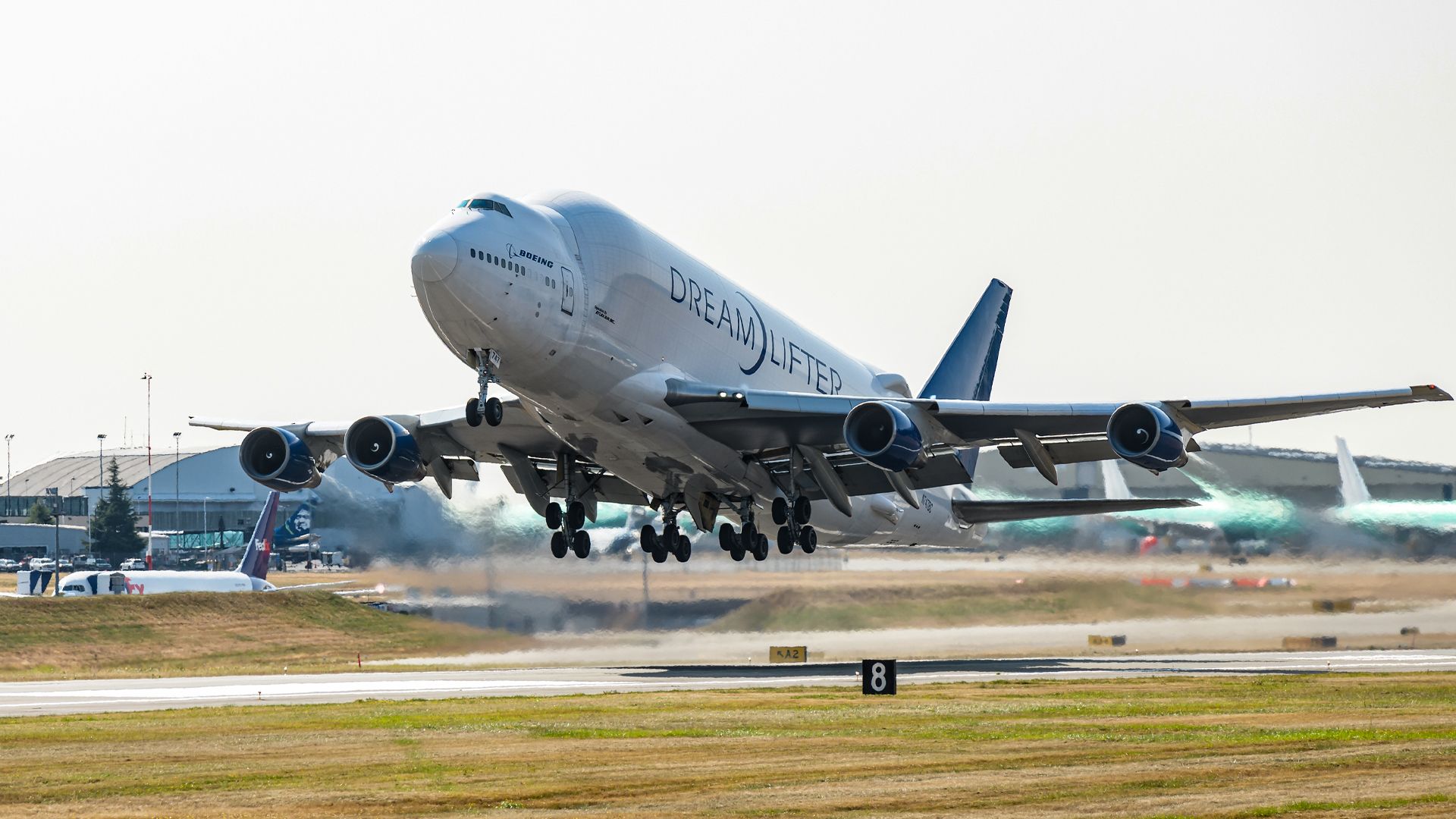
The Boeing Dreamlifter, a modified version of the 747-400, plays a crucial role in transporting large components necessary for the assembly of the 787 Dreamliner. This aircraft is vital to Boeing’s innovative strategy of outsourcing production to suppliers worldwide, with major components sourced from locations such as Italy and Japan. The Dreamlifter’s unique design allows it to carry oversized cargo to Boeing’s final assembly line in North Charleston, South Carolina.
Overview of the Boeing Dreamlifter
Officially designated as the 747-400LCF (Large Cargo Freighter), the Dreamlifter is one of only four in operation. Three of these aircraft entered service in 2008, with the fourth joining in 2010. Owned by Boeing and operated by Atlas Air, the Dreamlifters have a specialized design that accommodates the transport of large 787 components, including fuselage sections and wings.
The Dreamlifter’s modifications include a significantly enlarged fuselage to maximize cargo capacity. Unlike conventional freighters, the Dreamlifter features a massive cargo hold that is unpressurized and unheated, tailored to the specifics of its mission. This aircraft’s unique swing tail design allows for easy loading and unloading of cargo, which is essential given the size of the components being transported.
Capabilities and Limitations
The Boeing 747-400LCF is designed for light, oversized payloads. It has a maximum takeoff weight (MTOW) of 364 tons, which is lower than that of a standard 747-400. This design choice helps to mitigate landing fees, as the lighter aircraft incurs lower costs. Despite its limitations, the Dreamlifter’s operational range is approximately 4,200 nautical miles (7,800 kilometers) when fully loaded. This range is adequate for its longest scheduled route from Taranto, Italy, to North Charleston, measuring 4,472 nautical miles (8,283 kilometers).
The Dreamlifter regularly visits several key airports, including:
– Anchorage Ted Stevens International Airport
– Charleston International Airport
– Nagoya Chubu Centrair International Airport
– Taranto Grottaglie Airport
– Wichita McConnell Air Force Base
While the aircraft’s fuel consumption is higher due to its design, the lightness of the components being transported—many of which are made from composite materials—helps offset some of these costs.
The assembly process of the 787 Dreamliner is complex, with components manufactured at various locations around the globe. The Dreamlifter facilitates the transportation of these components, which are then assembled at the final production line in North Charleston. This innovative outsourcing model, while cost-effective in theory, has presented challenges for Boeing, including coordination issues among suppliers and quality control problems.
Boeing’s strategy for the 787 relies heavily on the Dreamlifter, illustrating the importance of this aircraft in modern aircraft manufacturing. Despite facing production difficulties that have resulted in financial losses, the demand for the 787 remains high, solidifying its status as a flagship model for the company.
The Dreamlifter stands as a testament to Boeing’s commitment to innovation in the aerospace industry. Its unique design and operational capabilities are essential to facilitating the assembly of the 787 Dreamliner, reflecting the ongoing evolution of aircraft manufacturing in a global economy.