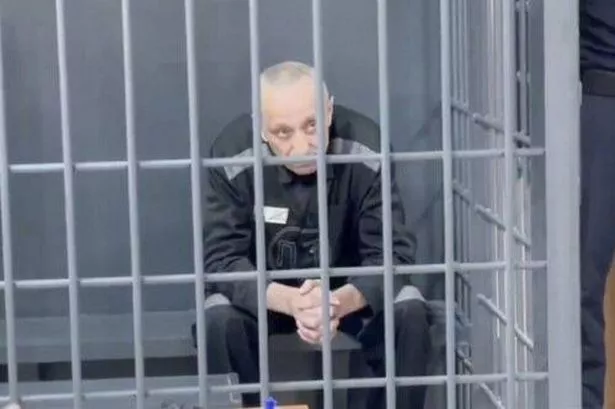
Mikhail “Werewolf” Popkov, a notorious figure in Russia’s criminal history, has been sentenced to an additional ten years in prison after a recent conviction for the murders of two more women. This ruling, handed down by an Irkutsk court, brings his confirmed victim count to an astonishing 92, as he continues to serve two life sentences plus an additional 19 years for his previous crimes.
Popkov, 61, who once worked as a police officer, is known for his gruesome methods of killing, which often involved sexual assault followed by brutal murders using various weapons such as axes, hammers, and knives. The latest convictions are linked to the 2008 murders of two 27-year-old friends, whose bodies were discovered near the Angarsk Electromechanical Plant.
The investigation revealed chilling details of how Popkov lured his victims. He confessed to wanting to “get acquainted” with the women after they rejected his advances. According to the Russian Investigative Committee, Popkov first strangled one woman while she was outside his car, then returned to kill her friend in the same manner.
Details of the Crimes and Background
These recent charges stem from a string of historical murders in Russia’s Primorsky region, located approximately 3,900 kilometers from Angarsk, where most of his crimes occurred. Following his departure from the police force, Popkov moved to Vladivostok, where he engaged in the resale of used vehicles while continuing his violent spree between 1992 and 2011.
Throughout this period, Popkov primarily targeted solitary women, claiming that his actions were a form of “cleansing” society of those he viewed as immoral, particularly prostitutes. In a statement to the court, he expressed disdain for women who left their families to party, asserting that they “abandoned their husbands and children at home.”
Psychiatric evaluations have suggested that Popkov suffers from homicidal mania, a condition characterized by an irrational desire to kill. Despite this diagnosis, he was deemed mentally competent to stand trial.
Russia has maintained a moratorium on capital punishment since 1996, leading to ongoing discussions about the possibility of reinstating the death penalty under President Vladimir Putin’s administration. Historically, executions in Russia were carried out by gunshot to the back of the head.
Personal Life and Motivations
Disturbingly, footage from family home videos shows Popkov in the 1990s, brandishing a knife while reciting a chilling children’s rhyme associated with wartime violence. This unsettling imagery juxtaposes his later claims in court, where he professed uncertainty about the total number of his victims, stating, “Committing the murders, I was guided by my inner convictions.”
Popkov’s motivations have been the subject of speculation, with one theory suggesting that his violent tendencies may have been exacerbated by personal issues, including suspicions regarding his wife, Elena. Alexey Mulyavin, a former colleague who had a brief affair with Elena, confirmed that Popkov eventually learned of their relationship. Mulyavin described the affair as youthful folly, stating, “It was a very short affair. We were young.”
Elena denied any wrongdoing, claiming that friends had used their home for a tryst. Popkov’s anger over the situation may have contributed to his violent outbursts. He remarked, “If I had seen the treason with my own eyes, I would perhaps have done everything differently.” His narrative highlights the complex interplay between personal betrayal and his heinous actions.
Mikhail Popkov’s case continues to shock and disturb, not only for the sheer number of lives he has taken but also for the chilling nature of his confessions and the motivations behind his crimes. With a confirmed victim count that may rise, the legacy of this serial killer remains a dark chapter in Russia’s criminal history.