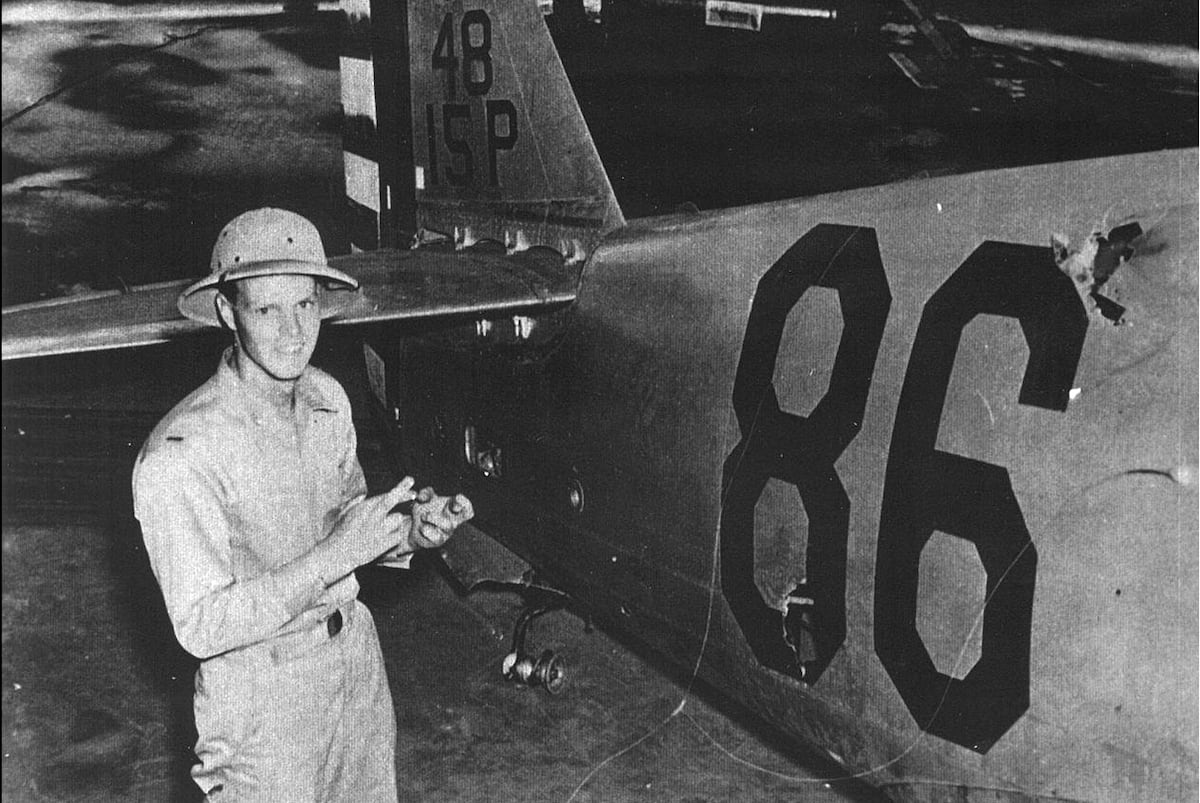
On December 7, 1941, during the attack on Pearl Harbor, Philip M. Rasmussen, a 23-year-old second lieutenant in the U.S. Army Air Corps, distinguished himself by becoming one of the few American pilots to take flight while Japanese planes still roamed the skies. Assigned to the 46th Pursuit Squadron stationed at Wheeler Field on the island of Oahu, Rasmussen’s quick actions would earn him a Silver Star and set the stage for a distinguished military career.
Rasmussen, who began flight training in September 1940, completed his training by April 1941. His squadron’s mission focused on defending against potential airborne threats, although the specifics about Japan remained largely unspoken. In his diary, he recorded a sense of looming conflict, particularly noting a letter from his father on December 2, where his father expressed concerns about Japan. By December 5, Rasmussen noted the seriousness of diplomatic failures between the United States and Japan.
As the attack unfolded, Rasmussen’s first indication of danger came shortly before 08:00. While in the barracks, he observed a Japanese aircraft dive towards the hangar, dropping bombs that caused a massive explosion. Realizing the gravity of the situation, he alerted his fellow officers, yelling that they were under attack. He quickly donned a webbed belt, secured a .45-caliber pistol, and ran toward the flight line.
Upon reaching the aircraft, he witnessed the chaos as Japanese planes strafed the airfield, igniting planes lined wingtip to wingtip. Rasmussen jumped into a Curtiss P-36, started the engine, and with the assistance of an armorer, loaded the aircraft with ammunition. Despite the harrowing conditions, he managed to taxi to safety and prepare for takeoff.
Engaging in Combat
Rasmussen and his squadron, including Lou Sanders and Gordon Sterling, took off in formation towards Pearl Harbor. They climbed to avoid clouds and prepare for combat, despite limited experience with enemy aircraft. As they neared Kaneohe Bay, they spotted the Japanese planes attacking. The pilots engaged the enemy, and during one encounter, Rasmussen fired upon a Japanese aircraft, watching it catch fire and crash.
However, the conflict intensified when another enemy plane attempted to ram him. In a moment of quick reflexes, he sharply pulled up, causing his canopy to shatter and his control to momentarily falter. Nevertheless, he managed to regain control and duck into the clouds to evade further attacks.
Rasmussen’s aircraft sustained damage, yet his determination to return to Wheeler Field remained steadfast. After a perilous journey, his fellow pilot Sanders escorted him back. Despite the chaotic environment, the friendly forces recognized them, allowing for a safe landing.
A Legacy of Valor
Upon landing, Rasmussen faced a damaged aircraft with no brakes due to hydraulic failure. He spun around on the grassy field before finally coming to a stop. Dazed yet unharmed, he disembarked, soaked with sweat and adrenaline. He changed into a flying suit and returned to assist others, as ammunition continued to explode around the hangars.
Rasmussen’s actions on that fateful day exemplified courage and quick thinking under pressure. He later flew numerous combat missions during World War II, including a bombing run over Japan, for which he received the Distinguished Flying Cross. His military career continued with assignments across the Pacific, Europe, and the Middle East, ultimately leading him to become the chief of operations at Eglin Air Force Base. He retired in 1965 with the rank of lieutenant colonel and passed away in 2005 at the age of 86, resting at Arlington National Cemetery.
His oral history, recorded in a 1991 interview, provides valuable insights into the mindset of a young pilot caught in one of America’s darkest hours. The narrative of his experience serves as a poignant reminder of the valor displayed by those who defended the nation during World War II.