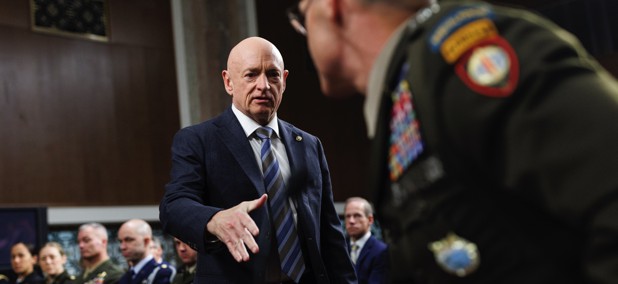
Arizona Democratic Senator Mark Kelly is contesting a decision by the Pentagon to downgrade his retirement rank and pay following his remarks to U.S. troops about their obligation not to follow illegal orders. On January 30, 2024, Kelly’s legal team filed a motion in federal court seeking to prevent the Defense Department from proceeding with these penalties, arguing that such actions infringe upon his constitutional rights.
In a detailed 35-page filing, attorney Paul J. Fishman asserted that the actions taken by Defense Secretary Pete Hegseth are punitive measures that violate multiple constitutional protections. Fishman emphasized that Kelly, as a decorated combat veteran and member of the Senate Armed Services Committee, is committed to maintaining good order within the armed forces. He stated, “His speech—simply reminding servicemembers of their fundamental obligation not to follow unlawful orders—promotes good order. And discipline does not demand silence—particularly from those no longer serving on active duty.”
The filing comes in response to the Department of Justice’s claim that the federal court lacks jurisdiction over the Defense Department’s disciplinary actions. Fishman refuted this assertion, arguing that it disregards extensive legal precedents that allow for judicial review of military practices. He stated, “Their claim that this Court is ‘not permitted to address’ Senator Kelly’s challenge disregards reams of precedent reviewing military disciplinary actions.”
Legal Proceedings and Pentagon’s Stance
Senior Judge Richard J. Leon, who was appointed by former President George W. Bush, had initially scheduled a hearing on this matter for February 1, 2024, but postponed it due to inclement weather.
Secretary Hegseth announced earlier in January that he had initiated the process to penalize Kelly, stating that his position as a sitting senator does not exempt him from accountability. Hegseth warned that further violations could lead to additional actions against Kelly. The Defense Department’s letter to Kelly accused him of undermining the military chain of command and promoting disobedience, which allegedly discredited the Armed Forces.
The video in question featured several Democratic lawmakers, including Kelly, Elissa Slotkin, Jason Crow, Chris Deluzio, Chrissy Houlahan, and Maggie Goodlander, all of whom have military or intelligence backgrounds. They collectively asserted that members of the military “can” and “must refuse illegal orders,” emphasizing that no one is obligated to execute directives that contravene the law or the Constitution.
First Amendment Rights and Retired Military Speech
Fishman contends that the current administration is advocating for a novel interpretation of the First Amendment, which would effectively strip retired military personnel of their constitutional right to free speech whenever the Secretary of Defense deems it potentially harmful to military discipline. He criticized the Justice Department’s position, which implied that retired officers could face repercussions for opposing Defense Department policies.
Fishman highlighted historical instances where retired military figures engaged in public discourse about military policy, from Alexander Hamilton criticizing President John Adams to retired generals vocalizing their dissent over the Iraq War. “Retired servicemembers, including Members of Congress, have openly criticized presidential decisions ranging from the Afghanistan withdrawal to vaccination requirements,” he noted.
The attorney asserted that the defendants’ attempt to limit the First Amendment rights of over two million retired servicemembers, all without judicial review, sets a dangerous precedent. As the case unfolds, it raises significant questions about the balance between military discipline and the constitutional rights of those who have served.
The outcome of this legal battle could have far-reaching implications for the rights of retired military personnel and their ability to participate in public discourse without facing punitive measures.