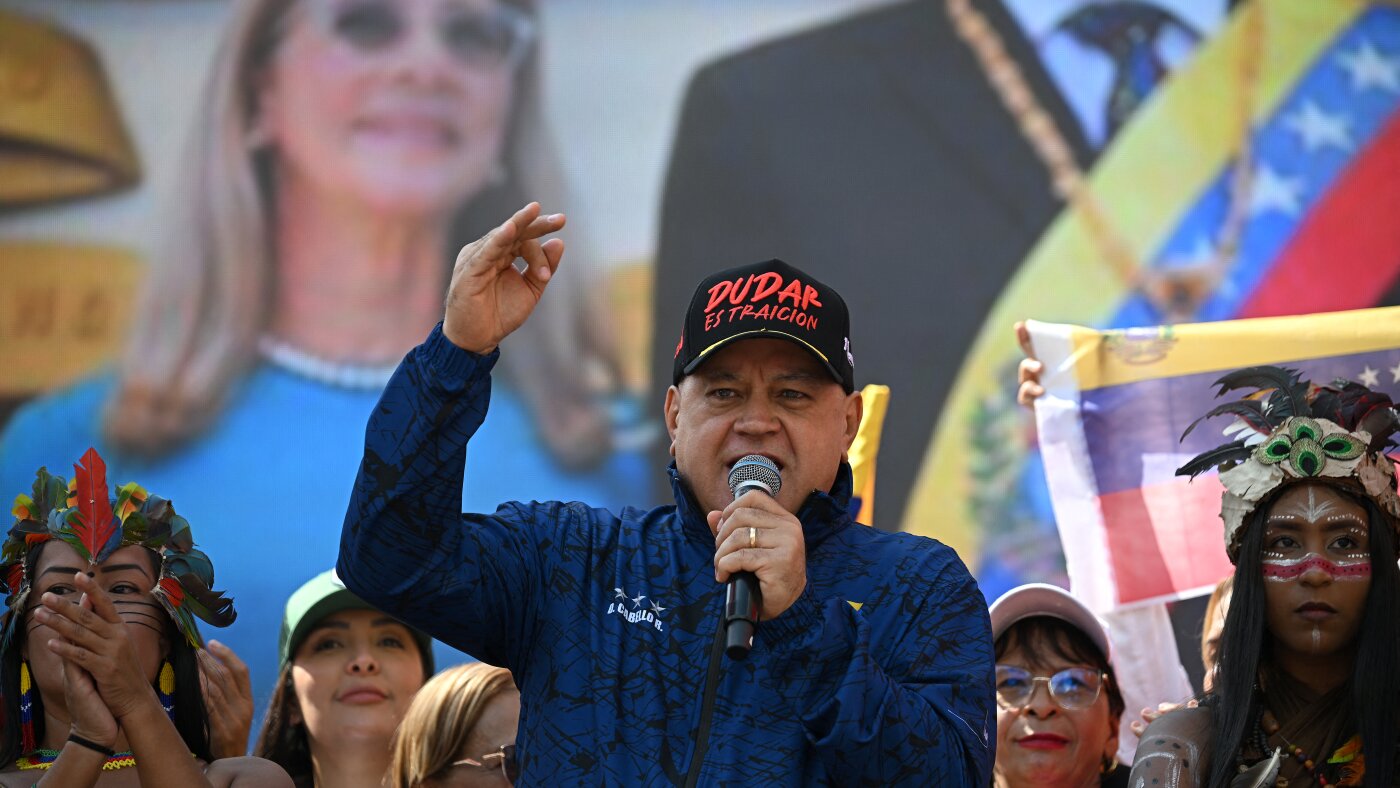
The recent capture of Venezuelan President Nicolás Maduro by U.S. special forces has sparked hopes for a democratic change in Venezuela. However, the anticipated political transformation has yet to materialize, largely due to the influential presence of Diosdado Cabello, Maduro’s hardline enforcer. Currently serving as Interior Minister under interim President Delcy Rodríguez, Cabello continues to dominate the government landscape.
In the immediate aftermath of the U.S. operation, Cabello appeared publicly in Caracas, donning a helmet and flak jacket. He labeled the U.S. intervention a “cowardly attack” and urged Venezuelans to resist what he termed a “terrorist enemy.” Standing alongside armed security forces, he rallied supporters to defend the sovereignty of Venezuela, warning that those perceived as traitors would face repercussions for questioning the Bolivarian revolution.
Cabello’s position remains precarious, as he faces serious allegations from the United States. He has been indicted on charges of drug trafficking and narco-terrorism, alongside Maduro and other associates. The U.S. government is offering a reward of up to $25 million for information leading to Cabello’s arrest, claiming he is a senior member of the Cartel de los Soles, a network of Venezuelan officials allegedly involved in cocaine trafficking to the United States. Cabello has consistently denied these accusations.
Despite these challenges, Cabello’s power within the Venezuelan government remains substantial. His influence is particularly critical as the administration attempts to navigate complex relations with the Trump administration following Maduro’s removal. During a recent White House press conference, President Trump did not recognize Cabello’s name, highlighting a disconnect between U.S. perceptions and Venezuelan realities.
Cabello, 62, is a prominent figure with deep ties to the late President Hugo Chávez, playing a significant role in the socialist revolution that began in the late 1990s. The two were involved in a failed military coup in 1992, which led to their imprisonment. After their release, Chávez ascended to the presidency in 1998, with Cabello becoming a key member of his inner circle and holding various significant government positions.
His influence soared during the 2024 political crisis, when Cabello was appointed as Interior Minister after widespread protests erupted over allegations of electoral fraud in the presidential elections. Under his leadership, a crackdown ensued, resulting in the deaths of 24 individuals and over 2,000 arrests, according to Human Rights Watch. Cabello continues to oversee the police force and pro-government armed groups known as colectivos, which have been implicated in violent reprisals against dissenters.
The ongoing power struggle complicates efforts to establish a stable political environment, a condition the Trump administration seeks to facilitate for the potential exploitation of Venezuela’s oil resources. Zair Mundaray, a former Venezuelan public prosecutor, emphasized the challenges of achieving legal stability while Cabello wields such power, questioning the feasibility of a peaceful transition.
Human rights activists have criticized Cabello for obstructing the release of political prisoners, which was announced over a week ago as part of a government initiative to promote national unity. His weekly television program, Con el Mazo Dando (“Hitting with the Hammer”), continues to serve as a platform for his attacks on opposition figures, including Nobel Peace Prize recipient Maria Corina Machado, whom he branded a “fugitive from Venezuelan justice.”
The atmosphere remains unsafe for many opposition figures who have fled the country. Venezuelan economist Ricardo Hausmann stated during a Harvard University panel discussion that returning to Venezuela is too dangerous while Cabello and other hardliners, such as Defense Minister Vladimir Padrino López, remain in power. He remarked, “The government in Venezuela is the same Chavista government we saw before,” indicating the continuity of the regime’s oppressive tactics.
As tensions persist, President Trump has warned of possible military responses should Maduro loyalists, like Cabello, threaten U.S. interests. Analysts suggest Cabello may face a critical decision: either negotiate a deal for exile or work with the interim government to maintain his position. Geoff Ramsey, an analyst at the Atlantic Council, noted that Cabello’s best chance for avoiding the fate that befell Maduro lies in coordinating with Rodríguez, though his ambitions are unlikely to diminish.
The current political climate in Venezuela reveals a complex interplay of power dynamics, with Cabello remaining a formidable obstacle to the democratic aspirations of many Venezuelans. As the country navigates this turbulent period, the international community watches closely, aware that the path toward democracy remains fraught with challenges.