A new research initiative at the University of North Dakota (UND) aims to bolster satellite communication capabilities using laser technology. The project, led by Markus Allgaier, assistant professor of physics and astrophysics, will enable both local businesses and university students to communicate with satellites more effectively. The initiative recently reached a significant milestone with the installation of lab equipment atop Witmer Hall.
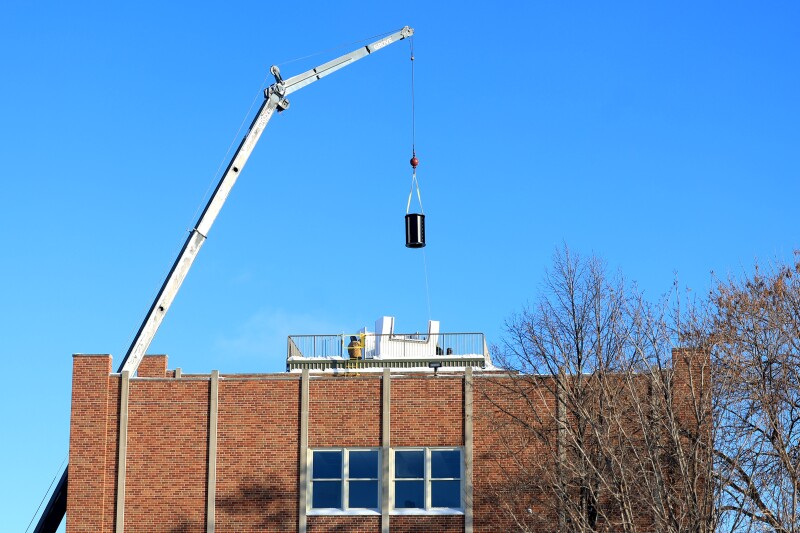
The Free-Space Optical Communication Lab is divided into two sections—one on the roof and another in the basement of Witmer Hall. The rooftop facility features an observatory and telescope equipped with optics designed to direct lasers at satellites and gather data from them. According to Allgaier, this aspect of the technology presents the greatest challenge. The observatory was originally scheduled for installation on December 9, 2023, but adverse weather conditions delayed the process until the following day.
Despite the challenges posed by wind and snow, the installation was completed by 13:00 on December 10. Allgaier expressed the dual nature of the experience, stating, “It was exciting, but also stressful.” He reflected on the extensive planning that went into the project over the past two and a half years.
The basement lab provides a controlled environment for laser experiments, featuring stable temperature conditions and specialized tables to minimize vibrations. The dual functions of the lab include creating a comprehensive facility for laser communication that adheres to commercial standards and addressing academic research questions.
This project also serves local interests. The Space Development Agency will operate its satellites in part from the nearby Grand Forks Air Force Base. Some contractors engaged in daily satellite link operations and ground station construction are actively recruiting graduates from UND. Allgaier highlighted the importance of this collaboration, stating, “We can train students from the region for jobs in the region that need that kind of skill.”
Funding for the lab was secured through a request made by UND before the 2023 legislative session. The university received $5 million for this research infrastructure project, which Allgaier noted has benefitted local businesses through the engagement of contractors like Sand Steel from Emerado and AE2S. Students have already begun utilizing the basement lab for their experiments, with three PhD candidates and one master’s student among those actively engaged in research.
In addition to current projects, Allgaier is contemplating the introduction of upper-level electives focused on optics and lasers. He emphasized that the lab will be accessible to all students at UND, fostering collaborative opportunities for a diverse range of scientific disciplines. “Anyone at UND can use the facility,” he remarked.
Allgaier’s involvement with the project predates his official appointment at UND, which began in January 2024. He had signed his contract in March 2023 and spent the intervening months consulting with contractors about feasible technical implementations within the allocated budget. Drawing from his experience building three other optics labs, this initiative at UND marks his first opportunity to curate a “wish list” of desired features.
He described the technology development as a “chicken and egg” situation, noting that the lab represents one of the first ground stations of its kind. This initiative follows the establishment of the SDA’s first ground station. Allgaier conveyed the challenges faced in the field, stating that discussions about building ground stations often stall due to a lack of existing missions utilizing laser communication. Conversely, there is hesitance to initiate missions without adequate ground station infrastructure.
“You need to overcome by putting a little bit of faith in that this will be a technology that will be used,” Allgaier said. By the end of spring 2026, all necessary hardware is expected to be installed at the lab, although the integration process will take additional time.
With this new facility, UND positions itself at the forefront of satellite communication research, bridging academia and industry while preparing students for future careers in a rapidly evolving technological landscape.