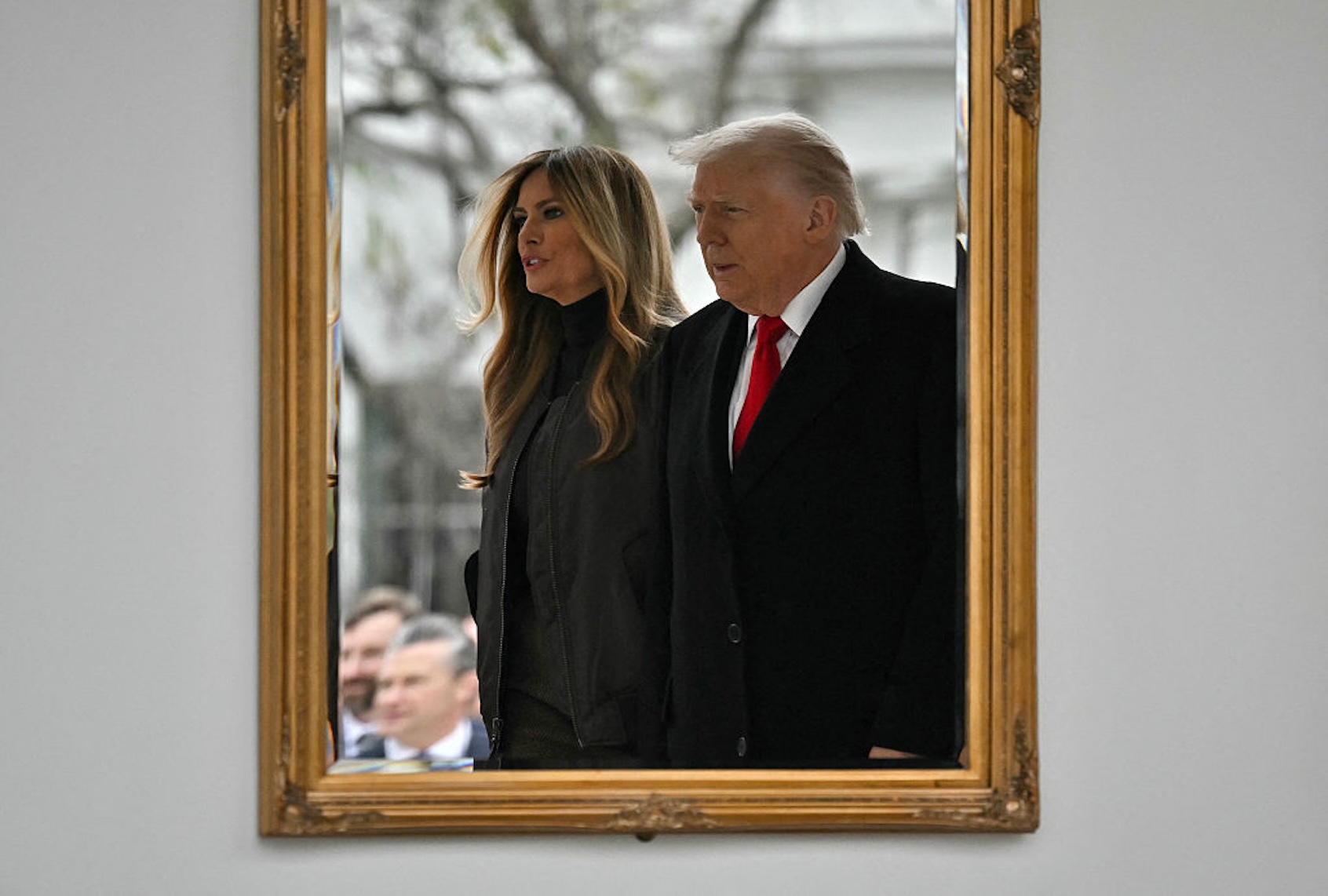
Donald Trump’s presidency has increasingly taken on the characteristics of a political “hall of mirrors,” where reality is distorted to reflect his personal narrative and ambitions. This phenomenon not only affects his administration but also challenges the broader political landscape in the United States and beyond. The implications of this altered perception have created a divide between Trump’s supporters and those who adhere to traditional democratic norms.
The administration has actively sought to reshape historical narratives. A striking example is the Smithsonian’s National Portrait Gallery, which has removed text accompanying Trump’s portrait that referenced his two impeachments. Additionally, official accounts of the events surrounding the January 6, 2021, Capitol attack have been sanitized. The White House now describes that day as “peaceful” and “orderly” until provoked by police, a characterization that is widely disputed.
Political Culture and Loyalty Rituals
Cabinet meetings under Trump have evolved into sessions that resemble loyalty rituals, where officials praise his leadership and vision. This environment is reminiscent of authoritarian regimes, with the president’s image displayed prominently across federal buildings. His name has been added to the Kennedy Center, now officially titled the Donald J. Trump and the John F. Kennedy Center for the Performing Arts. Furthermore, Trump’s plans include significant renovations to the White House, such as constructing a grand ballroom bearing his name.
As noted by POLITICO’s Jonathan Martin, Trump has transformed the presidency into what can be likened to an “adult fantasy camp.” This characterization captures the essence of a leader who prioritizes personal gratification over institutional integrity. The administration’s approach reflects a broader trend of diminishing democratic norms and accountability.
The motivation behind these actions appears to extend beyond personal vanity. Trump’s presidency has become a vehicle for an Orwellian project aimed at rewriting America’s public memory. This manipulation of truth serves to undermine democratic principles and the rule of law.
International Impact and Neo-Royalism
Trump’s foreign policy decisions mirror his domestic approach, often driven by personal interests. His administration’s military actions, such as the recent offensive against Venezuela, highlight this troubling trend. The State Department has framed such interventions under a revised interpretation of the Monroe Doctrine, asserting American dominance in the Western Hemisphere. This strategy reflects what political scientist Monica Duffy Toft describes as “America the Bully,” where the U.S. acts unilaterally to exert control over other nations.
Trump’s ambitions are not limited to Venezuela; he has also expressed interest in Cuba, Colombia, and even Greenland. The notion of acquiring Greenland resonates with his desire for territorial expansion and power consolidation. This imperialistic mindset, often referred to as neo-royalism, positions Trump’s personal interests as synonymous with those of the United States.
The implications of this approach are significant. When foreign policy is dictated by personal ego, it can lead to catastrophic outcomes. The New York Times reported that a viral video of Venezuelan President Nicolás Maduro dancing to techno music became a catalyst for Operation Absolute Resolve. Such events underscore the dangers of a presidency driven by personal grievances rather than informed diplomatic strategy.
As Trump continues to navigate his political landscape, the survival of American democracy hinges on its ability to withstand the pressures of his ambitions. The challenge lies in maintaining democratic integrity in the face of a reality shaped by a leader whose narrative often diverges from established facts. The ongoing struggle for the soul of American democracy remains critical, as the influence of Trump’s “hall of mirrors” extends beyond national borders, impacting global perceptions of democracy and governance.