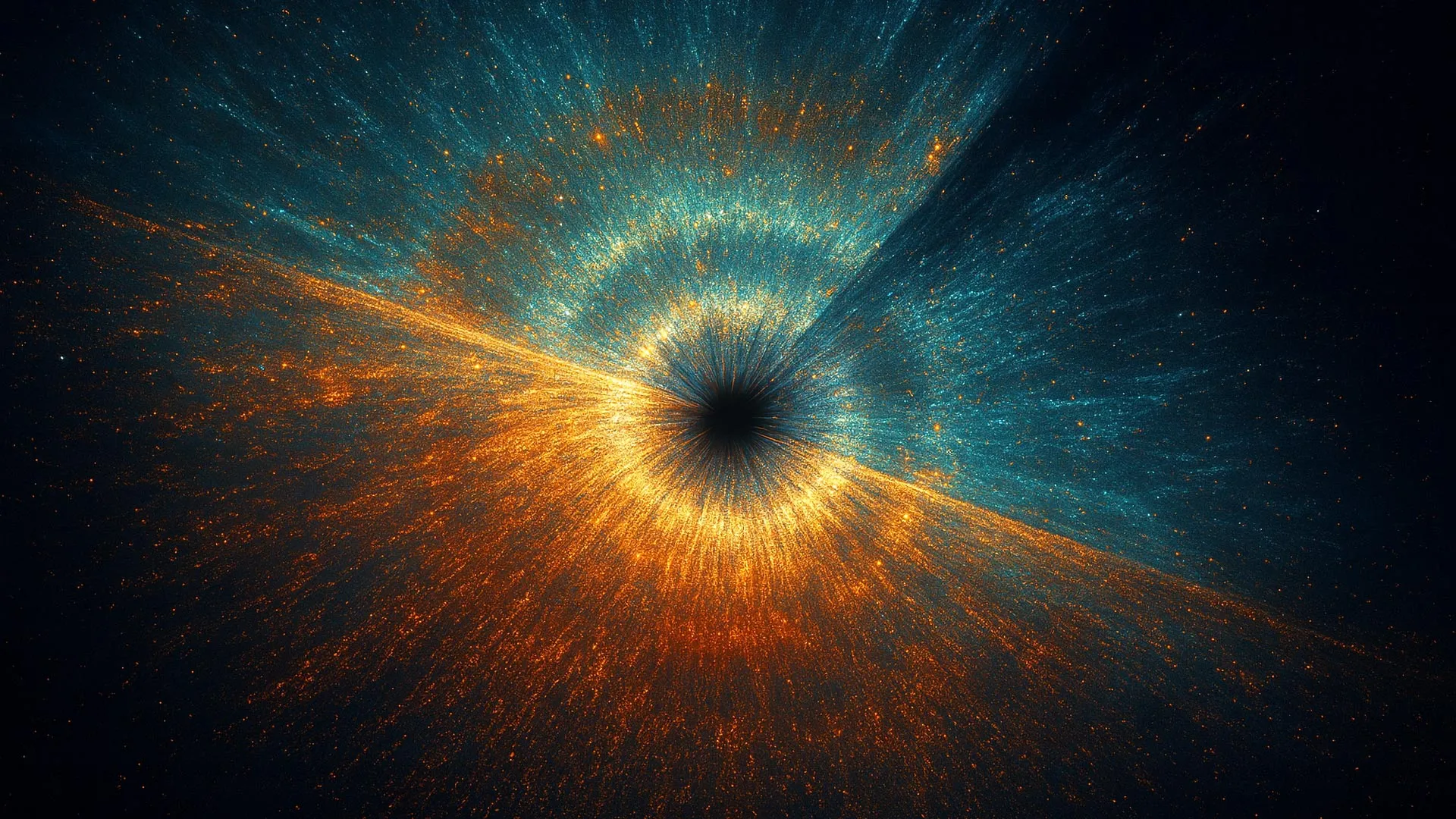
The James Webb Space Telescope (JWST) has achieved a significant milestone by capturing its clearest image yet of the area surrounding the supermassive black hole known as Sagittarius A*. This groundbreaking achievement was announced on October 7, 2023, showcasing the telescope’s advanced capabilities in observing cosmic phenomena. The image provides an unprecedented view of the black hole, located at the center of the Milky Way, revealing intricate details that could enhance our understanding of these enigmatic entities.
The new image illustrates the dynamic environment around Sagittarius A*, highlighting gas and dust clouds that swirl near the black hole’s event horizon. NASA and the European Space Agency (ESA) collaborated on this project, utilizing the cutting-edge technology of the JWST to explore the universe in ways previously thought impossible. This achievement builds on earlier observations made by the Hubble Space Telescope, which had previously captured images of the black hole, albeit with less clarity.
Significance of the Discovery
This latest image is not just a visual marvel; it carries significant implications for astrophysics. Researchers aim to use these findings to probe the fundamental nature of black holes, including their formation and evolution. The data collected from this observation will be published in an upcoming issue of the Astrophysics Journal, providing the scientific community with a deeper insight into the behavior of matter and energy in extreme gravitational fields.
The JWST operates in infrared wavelengths, allowing it to see through the dense dust that often obscures astronomical observations. This capability enables scientists to capture details about the gas surrounding Sagittarius A*, including its temperature and movement patterns. Such information is crucial for understanding how black holes affect their surroundings and influence galaxy formation.
Future Implications for Space Observation
The success of this imaging not only marks a triumph for the JWST but also sets a precedent for future astronomical studies. Scientists are optimistic that this technology will lead to more discoveries regarding other celestial bodies, enhancing our overall comprehension of the universe. Enhanced imaging will allow researchers to investigate distant galaxies, star formation, and even exoplanets more effectively.
Moreover, the collaboration between NASA and ESA emphasizes the importance of international partnerships in space exploration. As efforts continue to push the boundaries of what can be observed in space, the JWST stands at the forefront, promising to unveil more secrets of our universe in the years ahead.
The implications of these findings extend beyond theoretical astrophysics. Understanding the mechanics of black holes could eventually influence technologies on Earth, particularly those related to energy and material sciences. As researchers analyze the data from this latest observation, the potential applications of these cosmic discoveries may have far-reaching consequences for various fields.
In conclusion, the James Webb Space Telescope has not only delivered an extraordinary image of the black hole Sagittarius A* but has also opened new avenues for research and discovery in the field of astrophysics. The continued exploration of such cosmic phenomena promises to deepen our understanding of the universe and our place within it.