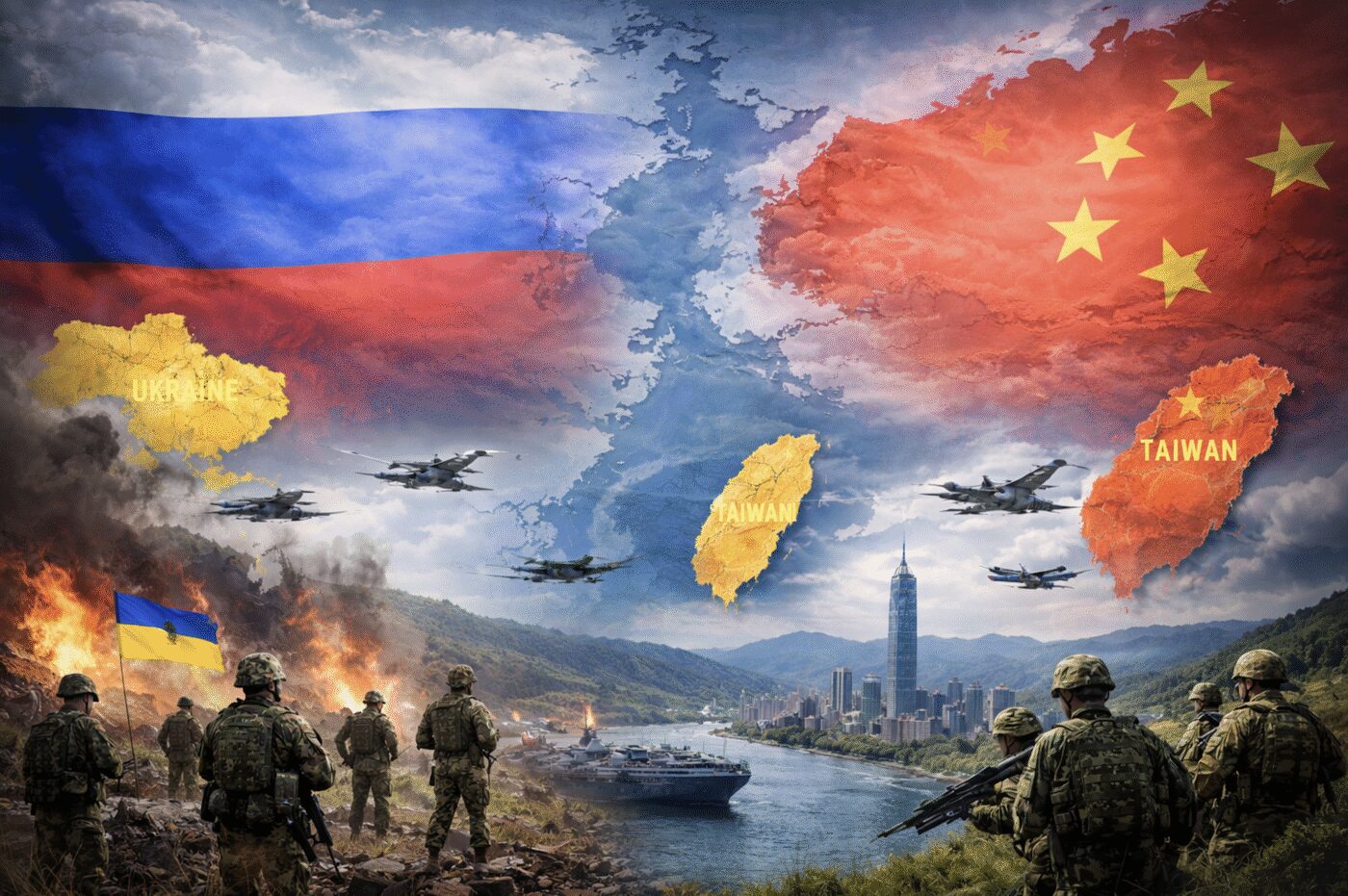
Tensions surrounding the geopolitical situations in Ukraine and Taiwan have intensified discussions about the potential for conflict. Analysts frequently draw parallels between the two regions, suggesting that Russia’s actions in Ukraine could foreshadow a similar approach by China towards Taiwan. However, the validity of these comparisons requires a nuanced understanding of the historical and cultural contexts of both situations.
Both Ukraine and Taiwan have undergone significant political changes in recent years, experiencing social movements that have shaped their national identities. In Ukraine, the 2014 Euromaidan protests marked a turning point, leading to a shift away from Russian influence towards a more European orientation. Similarly, Taiwan has witnessed a growing assertiveness in defining its identity separate from the People’s Republic of China (PRC). Despite these similarities, a deeper analysis reveals significant differences that complicate any direct comparison.
Corruption and Governance: A Shared Challenge
Corruption has been a persistent issue in both Ukraine and Taiwan, albeit manifesting in different forms. The Corruption Perception Index indicates that Ukraine has long been viewed as highly corrupt, with its score hovering around the low 30s, while Taiwan enjoys a relatively clean reputation, scoring in the mid-80s. Political leaders in both regions have utilized corruption allegations against opponents, exemplifying how governance can be weaponized.
In Ukraine, former President Victor Yanukovych used corruption charges against opposition leader Yulia Tymoshenko to consolidate power, a move later deemed politically motivated by the European Court of Human Rights. In Taiwan, the recent arrest of Ko Wen-je, head of the Taiwan People Party, on corruption charges has raised questions about whether political maneuvering influenced the prosecution. Despite these challenges, corruption alone does not justify military aggression from larger neighbors.
Historical Contexts: Divergent Paths
The historical narratives of Ukraine and Taiwan are crucial in understanding their current geopolitical situations. Ukraine has a long history of Russian influence, with significant portions of its population identifying as ethnically Russian. This history has led to a complex relationship marked by cultural tensions and territorial disputes. In contrast, Taiwan’s historical trajectory has been shaped by its colonial experiences, first under Japanese rule and later through the Chinese Civil War, which led to the Kuomintang’s (KMT) retreat to the island.
The KMT’s governance in Taiwan has involved efforts to enforce a unified Chinese identity, often suppressing indigenous cultures and languages. This historical imposition has created a distinct Taiwanese identity that resists assimilation into the PRC’s narrative. The ongoing cultural differences between Taiwan and mainland China emphasize the importance of historical context in evaluating potential conflicts.
Economic factors also play a significant role in these discussions. Ukraine’s economy has struggled post-Soviet Union, with widespread corruption and low economic freedom hampering growth. According to the Economic Freedom Index, Ukraine has consistently ranked low, often compared to struggling economies like Pakistan. Conversely, Taiwan has experienced robust economic growth, particularly in its technology sector, achieving high scores on economic freedom indices. The economic stability enjoyed by Taiwan creates a different scenario for potential conflict compared to Ukraine’s vulnerabilities.
While both nations face external pressures, the motivations for invasion differ significantly. Russia’s invasion of Ukraine is driven by strategic interests in the region, including access to resources and geopolitical influence. In contrast, China’s approach towards Taiwan is more focused on diplomatic and economic means rather than outright military confrontation. The PRC has historically emphasized economic integration and influence over military action, preferring to assert control through soft power mechanisms.
The potential for conflict in Taiwan remains a concern, particularly with the 2027 timeline highlighted by Chinese leadership for potential military readiness. However, the historical and cultural contexts strongly suggest that the PRC may prioritize non-kinetic methods of influence rather than a direct invasion, which would likely result in significant economic and human costs.
In conclusion, while parallels between Ukraine and Taiwan may seem compelling at first glance, a deeper examination reveals critical differences that challenge the notion of direct equivalence. Understanding these contexts is essential for any predictive analysis of future geopolitical developments. Both regions face unique challenges shaped by their histories, cultures, and economic realities, which will ultimately influence the responses of their larger neighbors. As the world watches, the emphasis should be on nuanced understanding rather than oversimplified comparisons.