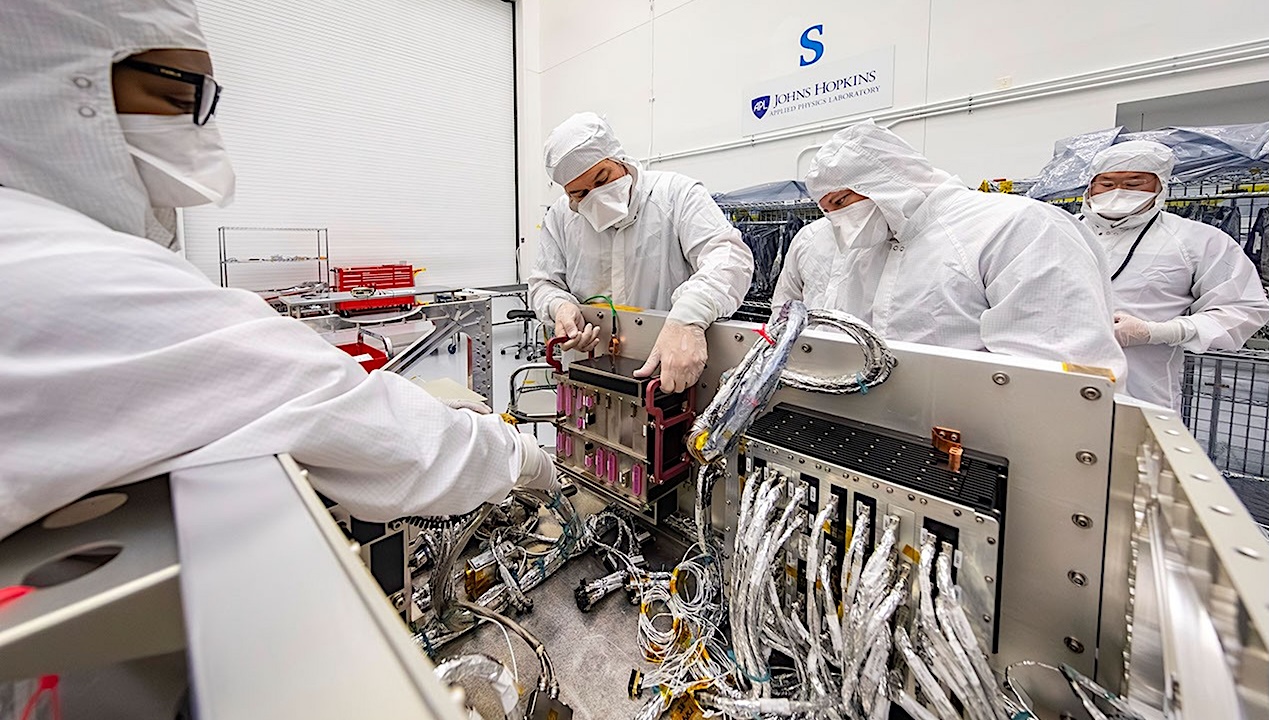
NASA’s ambitious Dragonfly mission has officially entered the integration and testing phase, a crucial step in assembling the rotorcraft lander designed for exploration on Saturn’s moon, Titan. These activities are taking place at the **Johns Hopkins Applied Physics Laboratory (APL)** in Laurel, Maryland. The mission aims to launch no earlier than **2028**, embarking on a six-year journey to study Titan’s diverse environments and assess the potential for life.
During the initial weeks of testing, engineers focused on two vital components: the Integrated Electronics Module (IEM) and the Power Switching Units (PSUs). The IEM, often referred to as Dragonfly’s “brain,” houses the spacecraft’s core avionics, including command and data handling, guidance, navigation, and communications in a compact, efficient design. Both the IEM and PSUs successfully passed their first power service checks, indicating readiness for subsequent steps.
Elizabeth Turtle, the principal investigator for Dragonfly at APL, expressed enthusiasm over this milestone. “This milestone essentially marks the birth of our flight system,” she said. “Building a first-of-its-kind vehicle to fly across another ocean world in our solar system pushes us to the edge of what’s possible, but that’s exactly why this stage is so exciting. The team is doing an outstanding job, and every component we install and every test we run brings us one step closer to launching Dragonfly to Titan.”
Ongoing Development and Testing
Significant groundwork has been laid leading up to this phase. The aeroshell and cruise-stage assemblies are progressing at **Lockheed Martin Space** in Littleton, Colorado. Meanwhile, an extensive series of aerodynamic tests was completed at **NASA’s Langley Research Center** in Hampton, Virginia. Testing continues in the Titan Chamber at APL, where foam insulation designed to protect the rotorcraft from Titan’s extremely low temperatures is undergoing evaluation.
The scientific instruments that will be part of Dragonfly’s payload are being assembled at various locations across the United States and internationally. Delivery of the flight radio has already occurred, with additional systems expected within the next six months for further testing.
Integration and testing at APL will persist throughout 2023 and into early **2027**. At that time, system-level testing is scheduled to take place at Lockheed Martin. Later in **2024**, the lander will return to APL for final space-environment testing before its scheduled launch at **NASA’s Kennedy Space Center** in Florida aboard a **SpaceX Falcon Heavy rocket** during the summer of 2028.
Significance of the Mission
The Dragonfly mission represents a pioneering effort in planetary exploration, taking a unique approach to studying extraterrestrial worlds. “Starting integration and testing is a huge milestone for the Dragonfly team,” said Annette Dolbow, the integration and test lead at APL. “We’ve spent years designing and refining this amazing rotorcraft on computer screens and in laboratories, and now we get to bring all those elements together and transform Dragonfly into an actual flight system.”
As the mission progresses, the team remains committed to pushing technological boundaries while aiming to enhance our understanding of life’s chemical origins. The Dragonfly mission embodies not only the spirit of exploration but also the collaborative efforts of government, industry, and academia working toward a common goal.