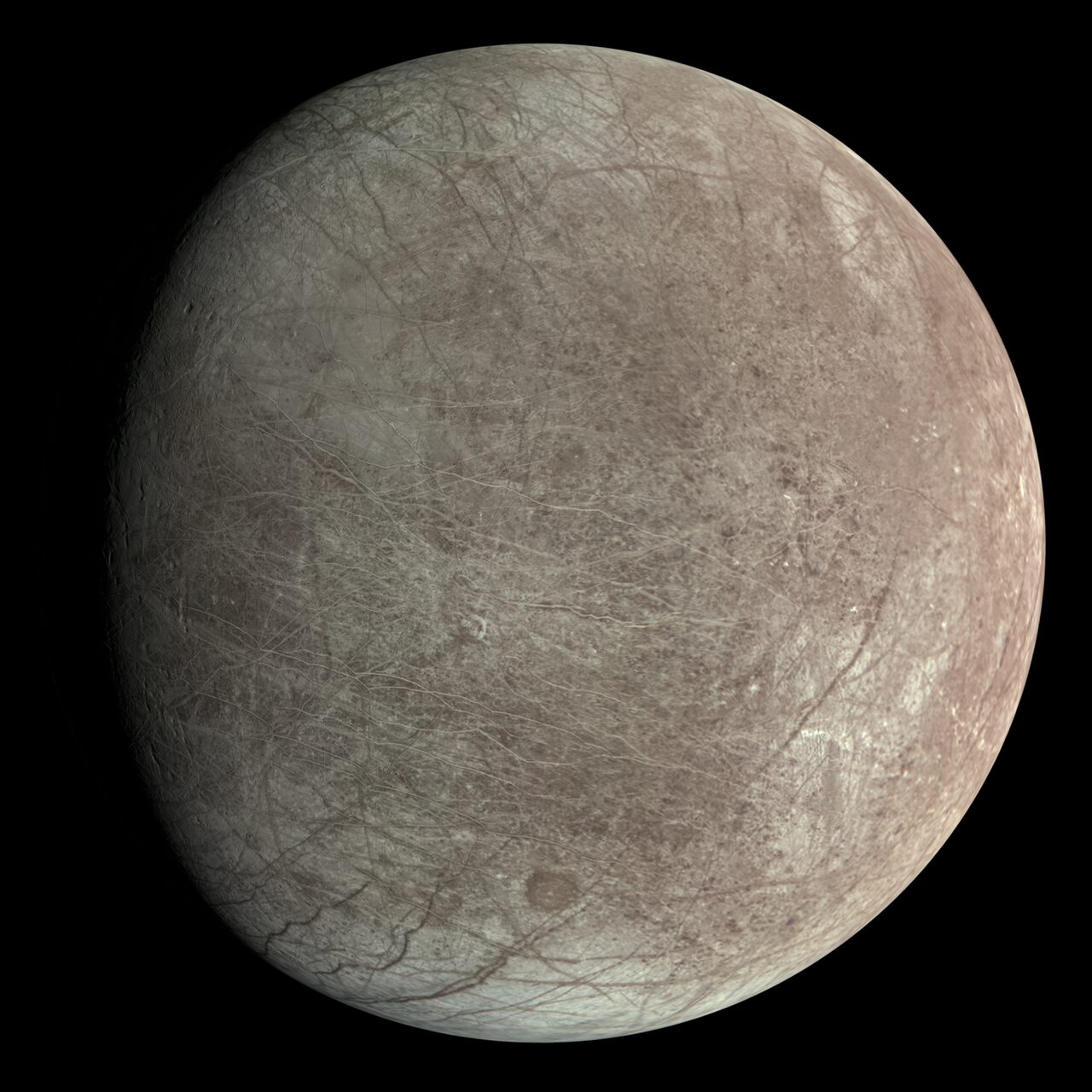
Researchers have uncovered new insights into Europa, one of Jupiter’s moons, suggesting that dynamic processes beneath its icy surface play a significant role in shaping its chemical landscape. A study utilizing data from the James Webb Space Telescope (JWST) provides compelling evidence of a hidden ocean beneath the moon’s frozen shell, potentially impacting our understanding of astrobiology.
The research team, led by Gideon Yoffe, employed a technique known as spectral decomposition to analyze observations from Europa’s leading hemisphere. This method allows scientists to identify and map the unique chemical signatures of various compounds based on how they absorb and reflect light. By examining nine spectral bands, the team focused on key substances such as water ice and carbon dioxide.
Previous findings had indicated the presence of carbon dioxide concentrated in a geologically chaotic region called Tara Regio. Initially thought to be a localized phenomenon, the latest analysis reveals that carbon dioxide enrichment extends far beyond this area. The distribution of carbon dioxide forms a broad, lens-shaped pattern across multiple chaotic terrains on Europa’s surface.
This discovery suggests that the geological processes affecting the moon are more complex than previously assumed. The presence of carbon dioxide, along with unusual textural properties of the ice, indicates that the surface may be influenced by subsurface dynamics. The findings imply that the microstructure of the ice itself may determine how and where volatiles like carbon dioxide are retained.
Notably, carbon dioxide is one of the six elements essential for life as we understand it. If the deposits on Europa’s surface are indeed originating from the subsurface ocean, as suggested by their concentration in geologically young regions, this ocean may contain crucial organic compounds. This interaction between the ocean and the surface raises intriguing questions about the potential for life on Europa.
As the Europa Clipper mission, a dedicated NASA initiative, prepares for its close flybys beginning in 2031, the chemical map created by JWST will guide its exploration. The findings from this latest study will inform where scientists should focus their investigations on Europa, enhancing our understanding of its geological and potentially biological processes.
In summary, the research led by Yoffe significantly advances our knowledge of Europa’s surface and subsurface interactions. With the potential for life in a hidden ocean, Europa continues to captivate scientists and researchers worldwide.