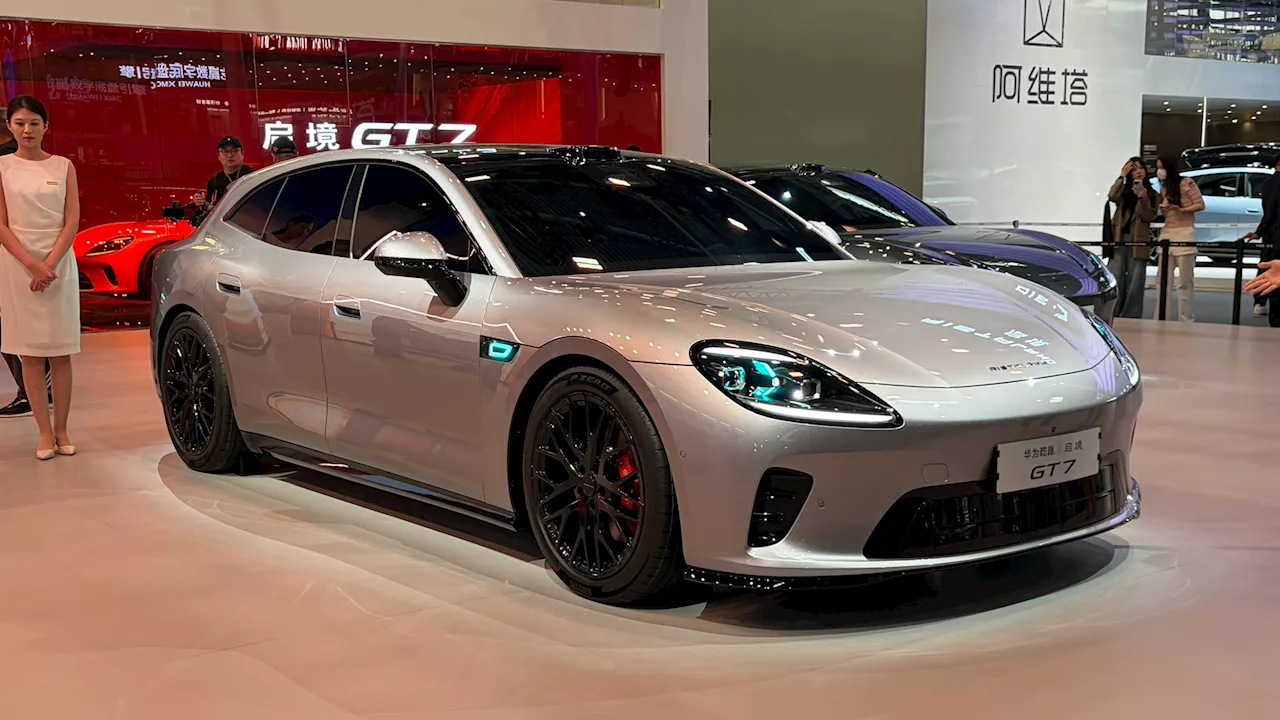
Huawei and GAC Launch Aistaland GT7 Electric Vehicle Inspired by Porsche Panamera
Huawei and Chinese automaker GAC have revealed the Aistaland GT7, a new electric vehicle that is turning heads for its striking resemblance to the Porsche Panamera. Unveiled at the Beijing Auto Show, this advanced EV blends cutting-edge technology with bold design, aiming to shake up China’s electric vehicle market within weeks.
The GT7’s dimensions closely mirror those of the Panamera — boasting a length of 5050mm, a width of 1980mm, a height of 1470mm, and a 3000mm wheelbase. For comparison, the Porsche Panamera measures 5052mm long and 1937mm wide, underscoring how closely inspired the Aistaland GT7 is.
Breakthrough Tech From Huawei Sets GT7 Apart
At the heart of the Aistaland GT7’s appeal is Huawei’s advanced technology. The EV incorporates intelligent projection Xpixel headlights capable of projecting road warnings directly onto the street, rivaling high-end systems used by luxury automakers like Mercedes-Benz.
More impressively, it features a high-definition 896-line Lidar system, far superior to the typical 192-line Lidar commonly found in competitors’ vehicles. This technology enhances nighttime driving safety by detecting objects as small as 14 centimeters from nearly 400 feet (122 meters) away, a critical advancement for active driving assistance systems.
Powertrain and Performance Details
The GT7 will be available in two versions: a full battery electric vehicle (BEV) and a range extender model (REX), the latter keeping the popular extended range option in China’s EV sector. Reports indicate a dual-motor all-wheel drive layout with battery cells supplied by China’s CATL, a global leader in EV battery manufacturing.
Notably, the range extender’s engine is positioned above the front axle, conforming to traditional performance configurations to balance power and handling. The vehicle also employs an 800-volt electrical architecture and features active suspension technology, promising a sophisticated driving experience that competes with premium European brands.
Availability and Market Focus
The Aistaland GT7 is expected to go on sale in China in around one month, though Huawei and GAC have not announced plans for international availability. The launch signals Huawei’s deeper push into the automotive industry, leveraging its expertise in telecom and AI for automotive innovation.
Curtis Moldrich, Digital Editor at CAR Magazine, notes this collaboration reflects growing tech crossovers in China’s EV industry with automakers embracing new digital and AI-driven features.
Impact for U.S. and South Carolina Audiences
Though initially targeting China, the development signals aggressive global competition from Chinese EV makers powered by tech giants like Huawei. With South Carolina’s growing role in automotive manufacturing and EV supply chains, innovations from China demand attention as U.S. makers race to keep pace with fast-evolving tech standards.
The Aistaland GT7’s advanced Lidar and intelligent lighting point towards future safety and autonomous driving tech that American consumers will demand soon, raising the stakes for domestic EV development and regulation.
Next Steps
U.S. industry watchers should monitor Huawei and GAC’s next moves, including potential export plans or technology licensing. The GT7’s imminent market entry in China will also provide key data on consumer acceptance for high-tech Chinese EVs modeled on luxury European designs.
South Carolina’s automakers and policymakers will want to stay alert to such trends shaping global EV competition, with direct implications for manufacturing, innovation investments, and consumer expectations.
For now, the Aistaland GT7 establishes Huawei and GAC as formidable new players in the EV race with a model clearly designed to challenge established luxury brands on both design and technology.