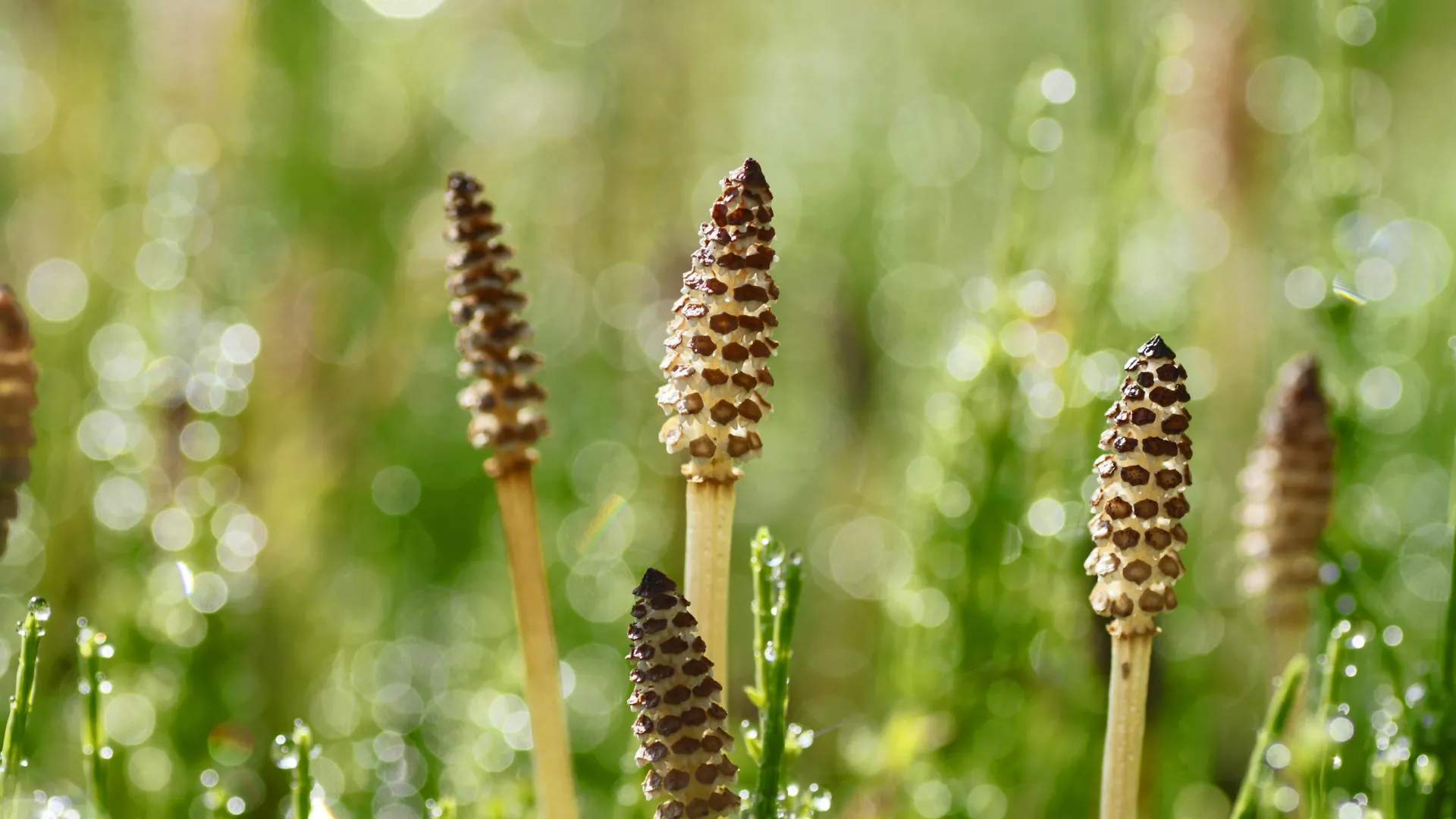
BREAKING: Scientists have made a groundbreaking discovery that a 400-million-year-old plant known as horsetail creates water with bizarre oxygen isotope signatures, resembling that of meteorites. This urgent revelation, announced by researchers from the University of New Mexico, unveils a new method to decode ancient climate conditions, critical for understanding Earth’s past.
Led by Professor Zachary Sharp, the research team published their findings in the Proceedings of the National Academy of Sciences on November 13, 2025. The study reveals that living horsetails act as natural distillation towers, producing extreme oxygen isotopic variations that are more intense than anything previously recorded on Earth.
“This is a meter-high cylinder with a million holes in it, equally spaced. It’s an engineering marvel,” Sharp explained. The implications of this discovery are profound, providing scientists with a unique tool to interpret ancient humidity and climate patterns through isotopic analysis.
The research focused on Equisetum laevigatum, collected along the Rio Grande in New Mexico. Sharp’s team tracked how oxygen isotope values shifted from the base to the tip of these plants, uncovering readings that occasionally fell into ranges typically associated with extraterrestrial materials.
“If I found this sample, I would say this is from a meteorite,” Sharp stated during a presentation at the Goldschmidt Geochemistry Conference in Prague this past July. The newly acquired data not only updates existing climate models but also helps clarify long-standing puzzles regarding oxygen isotope measurements in desert plants.
The implications of this research extend beyond mere curiosity; it offers a valuable method for reconstructing climate in arid regions. Oxygen isotopes serve as essential tracers, helping scientists discern water sources, plant transpiration, and atmospheric moisture levels. However, heavy isotopes are rare, complicating predictions of environmental shifts.
Additionally, fossil horsetails have a remarkable ability to preserve climate records. Tiny silica structures known as phytoliths, found in these ancient plants, retain isotopic signatures for millions of years. Sharp likens these phytoliths to a “paleo-hygrometer,” enabling researchers to reconstruct humidity levels dating back to the age of dinosaurs.
“We can now begin to reconstruct the humidity and climate conditions of environments going back to when dinosaurs roamed the Earth,” Sharp emphasized. This new research not only highlights the significance of horsetails in Earth’s climate history but also expands the contributions of the University of New Mexico to the field of geosciences.
As this research continues to unfold, scientists are optimistic that it will enhance our understanding of ancient climatic behavior, potentially aiding current climate studies.
Stay tuned for more updates on this urgent scientific development that could reshape our understanding of Earth’s climatic history and the role of prehistoric plants in it.