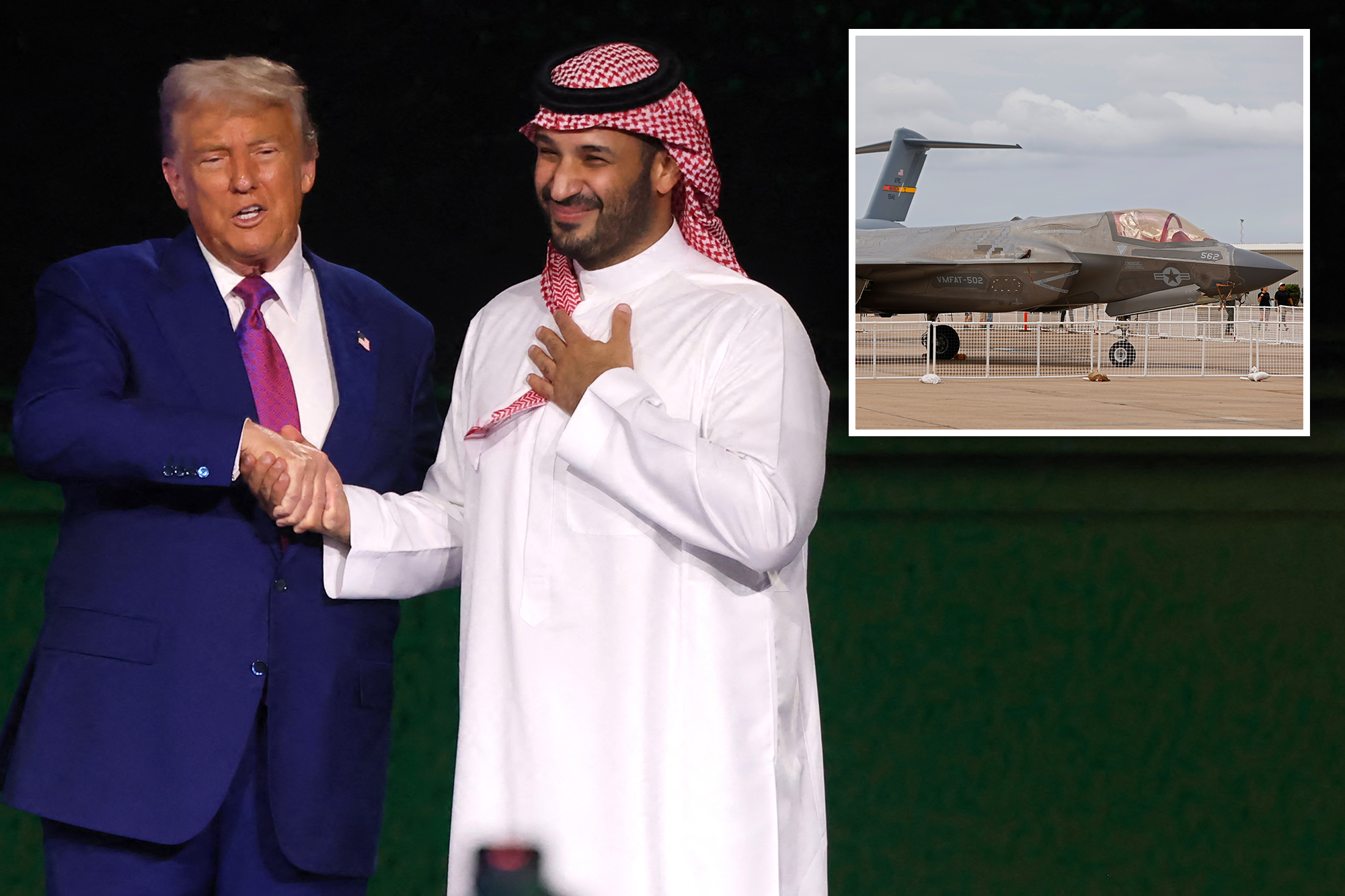
Israel is advocating for the United States to condition its sale of F-35 fighter jets to Saudi Arabia on the progress of diplomatic relations between Riyadh and Jerusalem. An unnamed Israeli official conveyed to Axios that while Israel does not oppose the sale, it believes that the transfer of these advanced aircraft should depend on Saudi Arabia’s commitment to normalization with Israel.
The official stated, “We told the Trump administration that the supply of F-35s to Saudi Arabia needs to be subject to Saudi normalization with Israel.” This stance reflects a shift from Israel’s previous objections to arms sales to Turkey, which the country firmly opposes. The official added that if the F-35 sale is part of a broader regional security cooperation under the framework of the Abraham Accords, similar to the agreement Israel has with the United Arab Emirates, Israel would be less concerned.
As discussions intensify, President Donald Trump and Saudi Crown Prince Mohammed bin Salman are scheduled to meet at the White House on March 7, 2024. The agenda includes a potential US-Saudi mutual defense agreement, which could pave the way for the F-35 sale. An Israeli official highlighted the strategic implications, stating, “It takes minutes for an F-35 to fly from Saudi Arabia to Israel.” Consequently, Israel is insisting that Saudi jets should not be stationed in western Saudi Arabia.
Failure to link the sale of these jets to normalized relations would be “counterproductive,” according to the Israeli official. The F-35, a stealth fighter jet capable of reaching speeds up to Mach 1.6 (approximately 1,200 miles per hour), is available in multiple variants. The F-35A is designed for conventional takeoffs and landings, the F-35B can land vertically, and the F-35C is tailored for aircraft carriers. Each unit costs at least $101.5 million.
Israel currently operates 45 F-35s and has 30 more on order, making it the only Middle Eastern nation with this advanced military capability, as reported by the Times of Israel. Trump noted that Saudi Arabia has expressed interest in acquiring “a lot” of fighter jets, with estimates suggesting the kingdom may spend billions on as many as 48 planes.
In May 2017, President Trump signed a landmark defense sales agreement with Saudi Arabia worth $142 billion. This agreement aimed to provide the kingdom with “state-of-the-art warfighting equipment and services from over a dozen US defense firms,” according to the White House. At that time, Trump voiced his “fervent hope” that Saudi Arabia would join the Abraham Accords, which have facilitated normalization between Israel and several Muslim-majority nations in the region.
Saudi Arabia has indicated that it desires Israel’s commitment to securing Palestinian statehood before formalizing its participation in the Abraham Accords. Following the White House meeting, Crown Prince Mohammed bin Salman is scheduled to attend a US-Saudi Business Council event at the Kennedy Center on March 8, 2024. This visit marks his first trip to the United States since the controversial killing of journalist Jamal Khashoggi in the Saudi consulate in Istanbul in 2018.
As these diplomatic discussions unfold, the implications for regional security and international relations remain significant, particularly regarding the balance of military power in the Middle East.