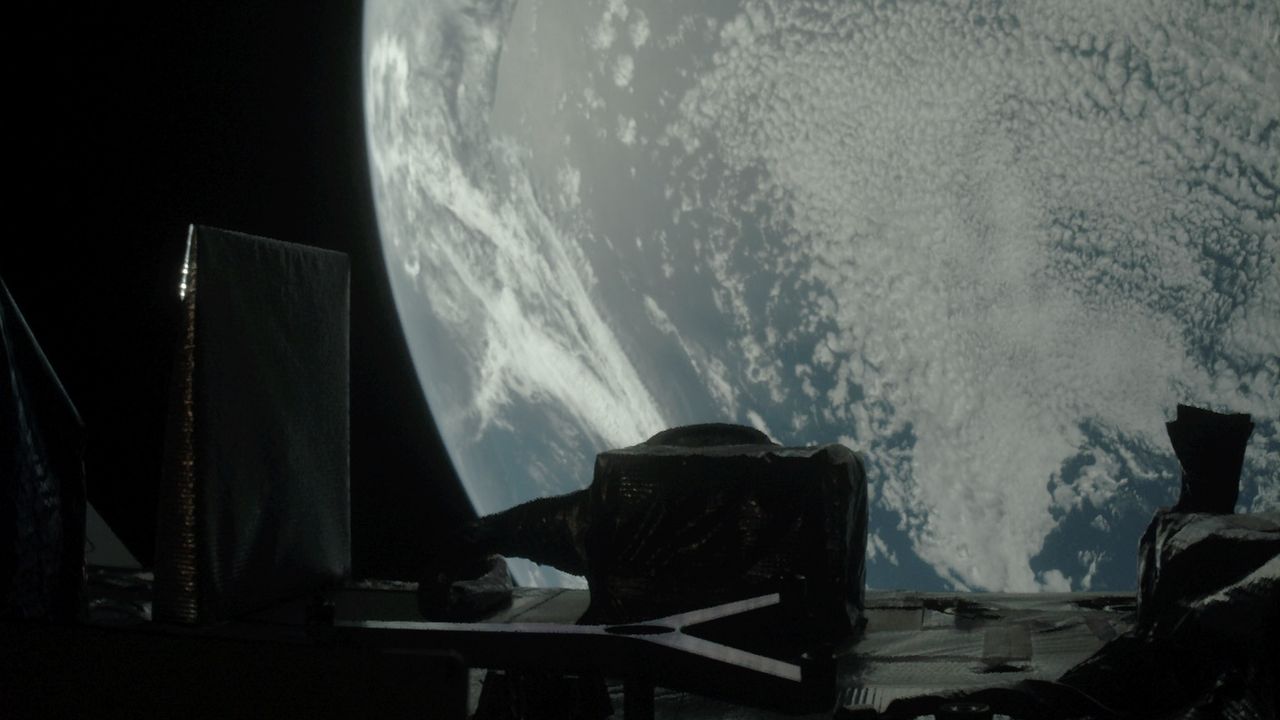
NASA’s OSIRIS-APEX spacecraft has recently captured breathtaking images of Earth as part of its high-speed flyby maneuver, propelling it toward the renowned asteroid Apophis. This flyby took place on September 23, 2025, when the spacecraft passed just 2,136 miles (3,438 kilometers) above the planet’s surface. The images reveal intricate details of swirling clouds over the blue oceans and glimpses of continents below.
As OSIRIS-APEX departed Earth, it took an impressive photograph of the Moon from approximately 370,000 miles (595,000 kilometers) away. These images confirm that the spacecraft’s cameras and instruments are fully operational after its extended journey through deep space, according to a statement from NASA.
Mission Background and Objectives
OSIRIS-APEX is the second phase of the OSIRIS-REx mission, which successfully returned a sample from the near-Earth asteroid (NEA) Bennu in 2023. Following this landmark achievement, NASA has redirected the spacecraft toward Apophis, a stony, metal-rich NEA. This asteroid presents a stark scientific contrast to Bennu, which is characterized by its carbon-rich composition. Apophis is notably significant as it was once considered to pose a potential impact risk to Earth.
The September flyby served a crucial purpose: using Earth’s gravitational pull to accelerate OSIRIS-APEX and guide it toward Apophis. The asteroid is scheduled to make a close approach to Earth on April 13, 2029. During this encounter, Apophis will pass closer than many satellites orbiting the Earth, with the gravitational forces potentially reshaping its surface and altering its spin or orbit.
Future Plans for OSIRIS-APEX
Once OSIRIS-APEX arrives at Apophis, it will become the first mission to document how an asteroid reacts during a close planetary pass. The spacecraft will spend approximately 18 months in orbit around Apophis, conducting detailed mapping, studying its composition, and capturing high-resolution images of the asteroid’s surface.
Mission planners are particularly excited about the potential to hover a few meters above Apophis and activate the probe’s thrusters. This action aims to stir up dust, revealing previously hidden material. These efforts will provide valuable insights into the asteroid’s properties and behavior, enhancing our understanding of such celestial bodies.
The images of Earth were taken using OSIRIS-APEX’s MapCam imager, which employs red, green, and blue filters, as well as the StowCam, capable of both still and video imagery. This technology is instrumental in verifying the safe storage of collected asteroid samples.
As the mission progresses, OSIRIS-APEX will continue to transmit trajectory updates, perform additional instrument checks, and eventually provide the first close-up views of Apophis. The findings could offer crucial information about how near-Earth asteroids evolve and respond to gravitational influences, further enhancing our knowledge of the solar system.