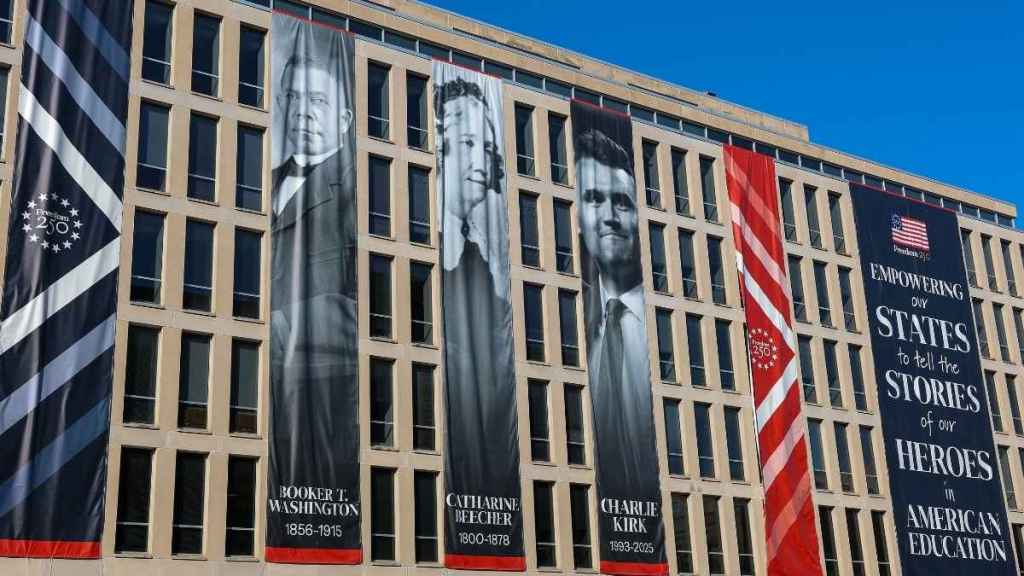
UPDATE: A banner featuring Charlie Kirk has just been installed at the Department of Education building in Washington, D.C., sparking immediate controversy. The banner was unveiled alongside portraits of five iconic figures in American education, including Martin Luther King Jr., Benjamin Franklin, Anne Sullivan, Booker T. Washington, and Catharine Beecher, as part of the celebrations for the nation’s 250th anniversary.
The installation of Kirk’s banner on March 2, 2026, has drawn significant backlash on social media, with many questioning the decision to honor a figure known for his controversial views on education. Critics point out that Kirk, founder of Turning Point USA, has publicly advocated against traditional college pathways, labeling higher education a “scam.”
One Twitter user slammed the decision, stating, “He’s a college dropout who discouraged secondary education.” Another echoed this sentiment, remarking, “Truly despicable! Charlie Kirk did not even graduate from college! What an embarrassment!” These reactions underscore the divisive nature of Kirk’s influence within educational discourse.
The new banners, which aim to “Empower our States to tell the Stories of our Heroes in American Education,” have led to heated discussions about who should be recognized in such a prominent space. While many laud the inclusion of historical figures like MLK and Franklin, Kirk’s presence beside them raises questions about merit and legacy in the educational landscape.
Kirk has long been critical of the traditional educational system, advocating for alternatives like entrepreneurship over four-year degrees. His book, The College Scam, criticizes current college teaching methods, arguing that they fail to prepare students for financial security and career success. In a previous interview with Fox News, he stated, “There must be an agreed-upon consensus that higher education has become a scam.”
As the debate unfolds, officials continue to defend the decision, emphasizing the importance of recognizing diverse contributions to education. However, the mixed reactions highlight a growing divide in public opinion regarding educational values and the figures who represent them.
What’s Next: The Department of Education is likely to face ongoing scrutiny as the public discourse continues. Observers will be watching closely to see if further actions will be taken in response to the backlash and how this controversy will influence future decisions regarding educational recognition.
Stay tuned for more updates on this developing story as it captures national attention and sparks further discussions on education in America.