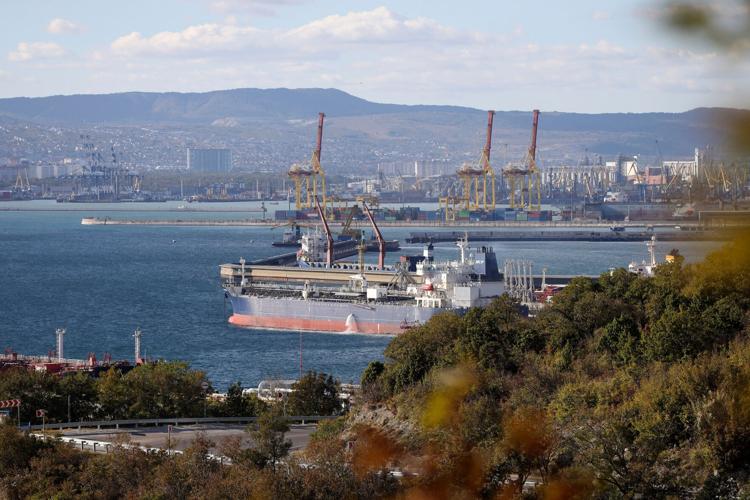
Rising energy prices caused by disruptions in the Middle East are enhancing Russia’s capacity to fund its military operations in Ukraine. The ongoing conflict in Iran has led to significant interruptions in oil and gas supplies, driving prices upward. In December 2023, prices for Russian oil exports were under $40 per barrel; they have since climbed to approximately $62 per barrel. This surge stems from fears surrounding the war and the near-total halt of tanker traffic through the Strait of Hormuz, which accounts for about 20% of the world’s oil consumption.
Despite trading at a discount compared to international benchmark Brent crude, which recently rose above $82 from a closing price of $72.87 on the eve of the U.S. and Israel’s attack on Iran, Russian crude has now surpassed the budgetary benchmark of $59 per barrel set by the Russian Finance Ministry for 2026. Oil and gas tax revenues comprise up to 30% of the Russian federal budget, making these increases crucial for the Kremlin.
Through January 2024, Russia’s state oil and gas revenue had dropped to a four-year low of 393 billion rubles (approximately $5 billion). The Russian budget recorded a shortfall of 1.7 trillion rubles (around $21.8 billion) during that month, the largest on record, according to the Finance Ministry. This decline is attributed to lower global prices and steep discounts enforced by U.S. and European Union sanctions targeting Russia’s primary oil companies, Lukoil and Rosneft.
Economic conditions have stagnated, primarily due to inflated military expenditures. To stabilize state finances, President Vladimir Putin has implemented tax increases and sought additional borrowing from domestic banks.
Implications of Rising Energy Prices
Energy expert Simone Tagliapietra from the Bruegel think tank in Brussels commented, “Russia is a big winner from the war-related energy turmoil. Higher oil prices mean higher revenues for the government and therefore stronger capability to finance the war in Ukraine.” As logistical disruptions continue in the Middle East, both India and China are likely to increase their reliance on Russian oil supplies, according to Amena Bakr, head of Middle East and OPEC+ insights at Kpler.
The price of natural gas in Europe has seen a dramatic increase, raising doubts about the European Union’s plans to eliminate imports of Russian liquefied natural gas (LNG) by 2027. Concerns about energy shortages similar to those experienced in 2022 persist, particularly if the conflict in Iran prolongs shipping disruptions.
Analyst Alexandra Prokopenko from the Carnegie Russia Eurasia Center in Berlin noted that the potential for a rapid resolution to the conflict could stabilize Brent prices around $65 per barrel. She suggested that sustained high oil prices could provide Russia with necessary fiscal relief, depending on their longevity.
A persistent closure of the Strait of Hormuz could lead to oil prices soaring to as high as $108 per barrel, potentially intensifying inflation and pushing European economies towards recession. Prokopenko remarked that such conditions would significantly benefit Russia financially.
Shifting Dynamics in European Energy Supply
The ongoing disruption in Gulf LNG production could prompt European nations to reconsider their approach to Russian energy contracts, especially those set to expire after April 25. Chris Weafer, CEO of Macro-Advisory Ltd, indicated that the EU might feel increased pressure to collaborate with the U.S. to find a resolution to the conflict in Ukraine and possibly ease plans for a comprehensive ban on Russian oil and gas imports.
Countries like Hungary and Slovakia, which have historically relied on Russian LNG, are expected to advocate for a review of these import restrictions. Weafer stated that the Russian federal budget is poised for an improved outcome in March due to reduced discounts on Russian oil and the presence of eager buyers.
Russian Deputy Prime Minister Alexander Novak confirmed that Russian oil is currently “in demand” and that the country is prepared to enhance supplies to China and India. The head of Russia’s sovereign wealth fund, Kirill Dmitriev, also weighed in on the situation, suggesting that European leaders should have prepared for the energy market’s volatility.
Despite the current geopolitical tensions, Belgium, France, the Netherlands, and Spain continue to import around 2 billion cubic meters of Russian LNG monthly. Hungary adds an additional 2 billion cubic meters through the Turkstream pipeline. According to Tagliapietra, this collective amount could reach 45 billion cubic meters by 2026, representing about 15% of total gas demand for the year. He emphasized the challenges of replacing this supply if the LNG market tightens further due to ongoing shutdowns in Qatar.
The financial implications of the Iran war on Russia’s energy exports signal a complex web of economic dependencies that extend beyond national borders, influencing global energy markets and geopolitical strategies alike.