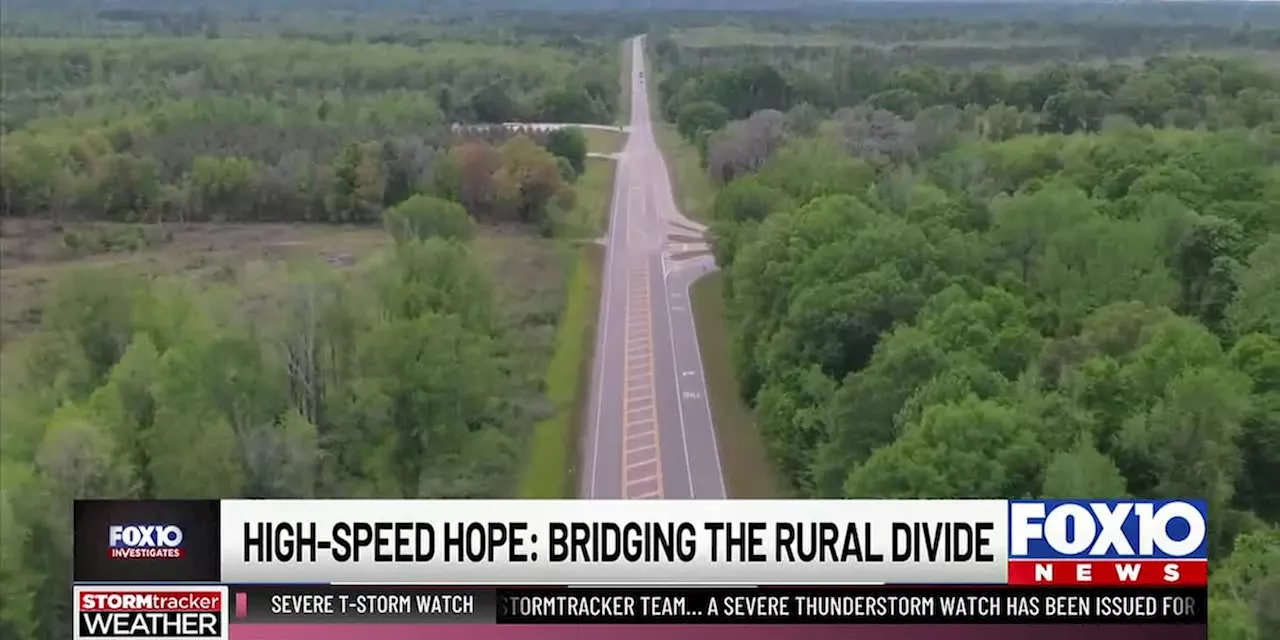
Communities in Washington County Struggle as High-Speed Internet Rollout Lags
Residents in Millry and Chatom, towns in rural Washington County, Alabama, face mounting frustration as reliable high-speed internet remains elusive despite ongoing fiber optic installation efforts. In tight-knit communities of just a few hundred people, slow internet is not just a nuisance—it’s a barrier to business, communication, and emergency access.
Lonnie Guy, a Millry native and owner of Nana and Papa’s Ice Cream and Sandwich Shop, recalls the days of dial-up internet and says access has improved only recently. Just months ago, fiber optic cable was laid to his home 11 miles west of Millry, delivering a dramatic boost in speeds and reliability that transformed both his business and daily life.
“I remember the days, back in the dial-up days, and you could slop the hogs and milk the cows and feed the chickens and do all that while the wheel was turning, before you could even get on internet,” Guy said.
However, this improved access is still far from universal. Chester Caulder, general manager of local ISP Millry Communications, explains the challenges in expanding fiber in such sparsely populated areas.
“Because we are such a rural community, in our service area, we average about 4.7 households per mile of fiber constructed,” Caulder said. “Fewer customers spread across large land areas make deployment slower and more costly.”
Caulder stressed that where fiber is available, customers get the full complement of high-speed internet they pay for, but many remain beyond the reach of the current network.
Urgent Need Persists in Chatom as Fiber Optic Work Drags
Just a few miles south in Chatom, the stakes feel higher because of the larger number of residents and businesses affected.
Landis Waite, a lifelong Chatom resident, explained how consistently slow internet is damaging daily life.
“Internet’s always been pretty much bad. It’ll take a few hours sometimes for a webpage to pull up or anything like that,” Waite said.
Fiber optic crews began working in Chatom years ago, but Waite and many neighbors say the project’s progress is painfully slow and unreliable.
“Fiber optic, we’ve heard, should make it better. But it’s just taking forever for us to get to that,” Waite said.
Fears over service outages ripple through the community. In March, a resident posted on social media about internet and even ATM outages, underscoring deep connectivity issues.
Waite described his own struggles to stay connected.
“When my internet’s down, I ain’t getting no notifications from nobody. No texts, no calls. I gotta go out to the yard,” he said.
For Chatom residents, good internet isn’t a convenience—it’s critical for everyday communication and safety.
“If you get it stationed at your house, you should have good service. At least enough for a phone call. I gotta walk down to my grandma’s house just to get a hold of her cause I can’t call her off Wi-fi,” Waite said.
What’s Next for Rural Broadband? Expansion Efforts Face Cost and Logistics Challenges
While fiber optic deployment in Millry and Chatom is slowly advancing, the uneven pace and high costs of rural broadband development mean many residents are still left waiting. Providers like Millry Communications face tough economics extending service over vast rural areas, limiting how fast and how far broadband can reach.
Residents and local officials are watching closely for new funding or public-private partnerships that could accelerate these upgrades. For now, families and businesses in Washington County continue to cope with the challenges of unreliable internet in a world increasingly dependent on connectivity.
The situation in Millry and Chatom echoes broadband access struggles seen nationwide in rural America, underscoring the urgency to bridge the digital divide for communities across the South and beyond.